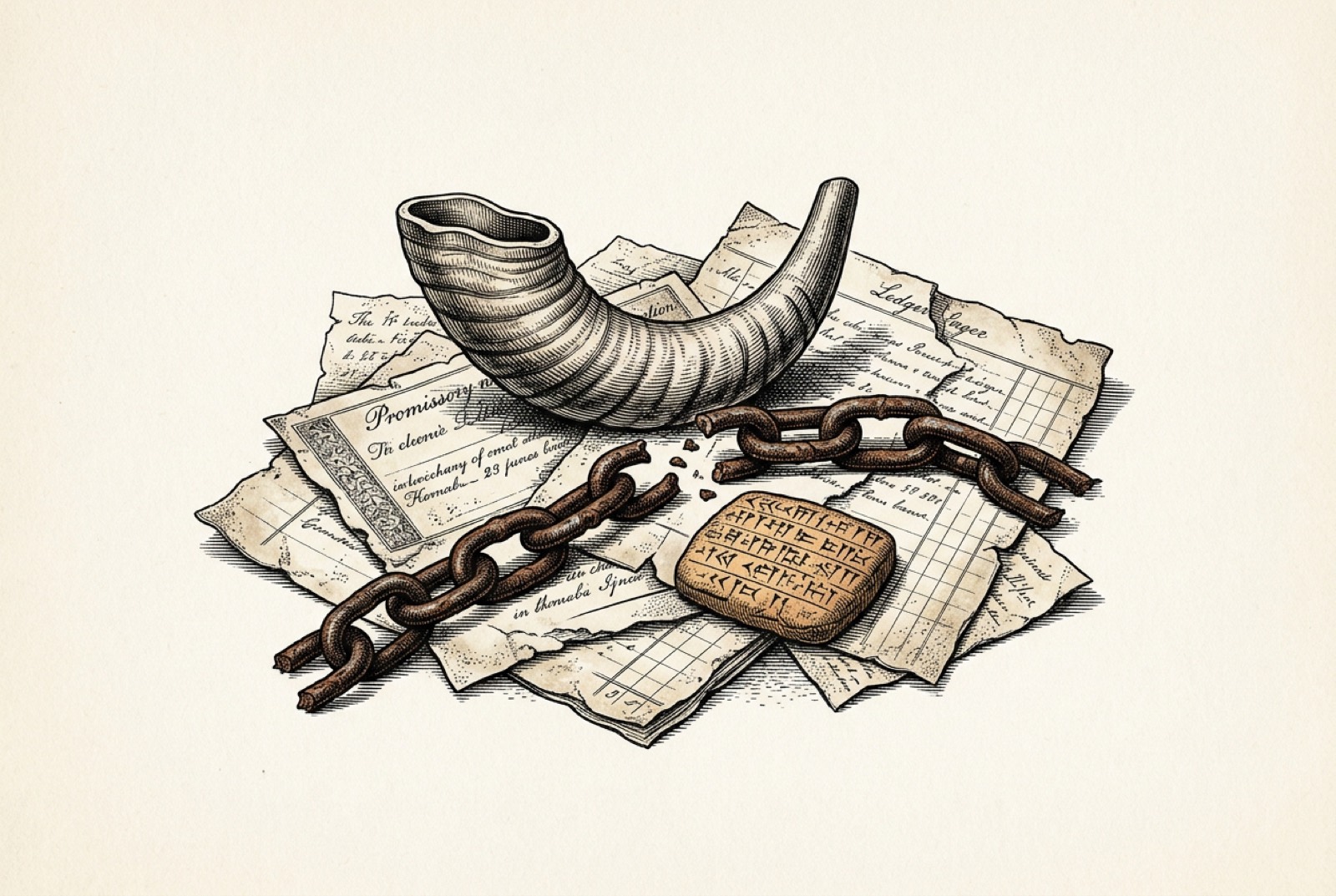
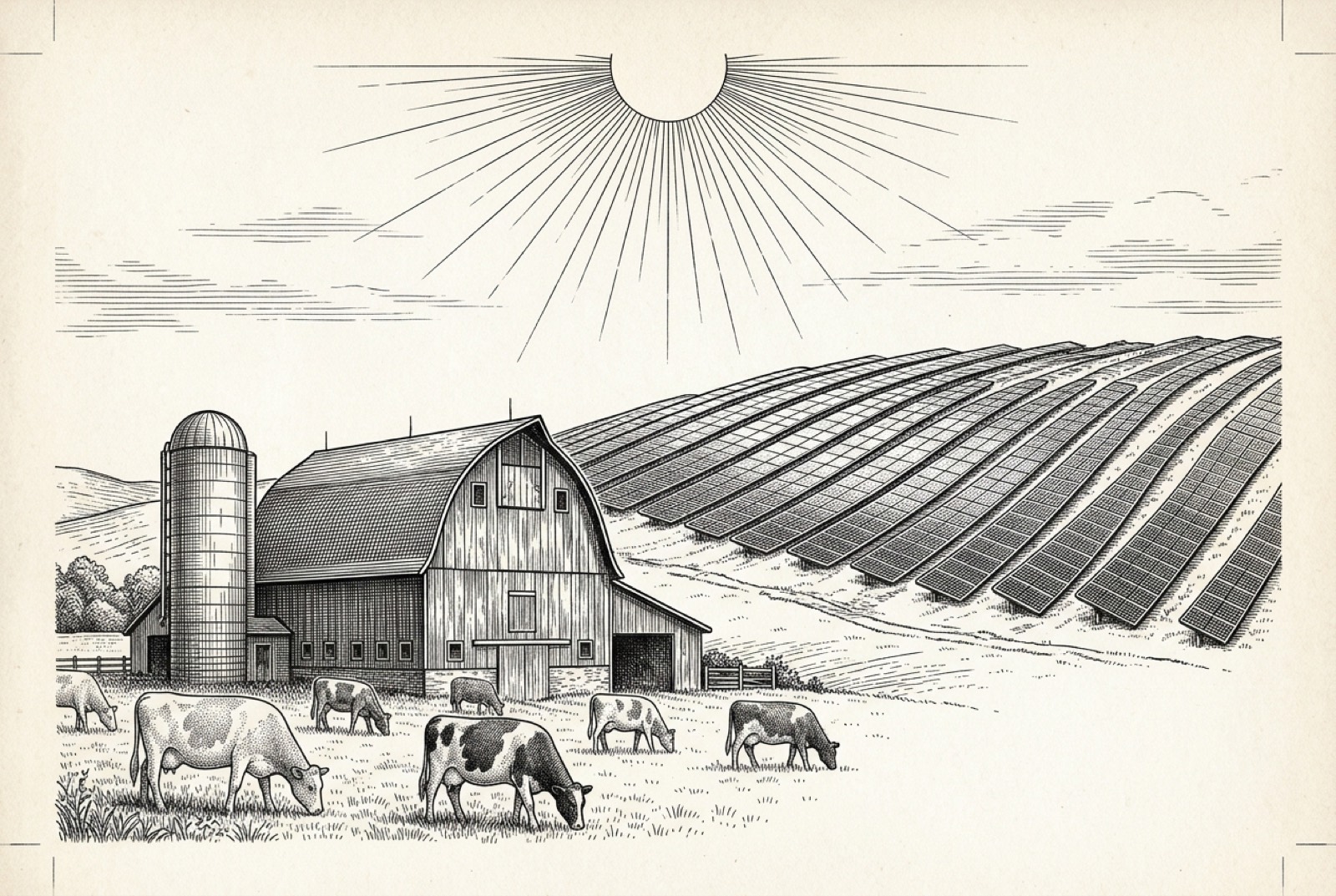
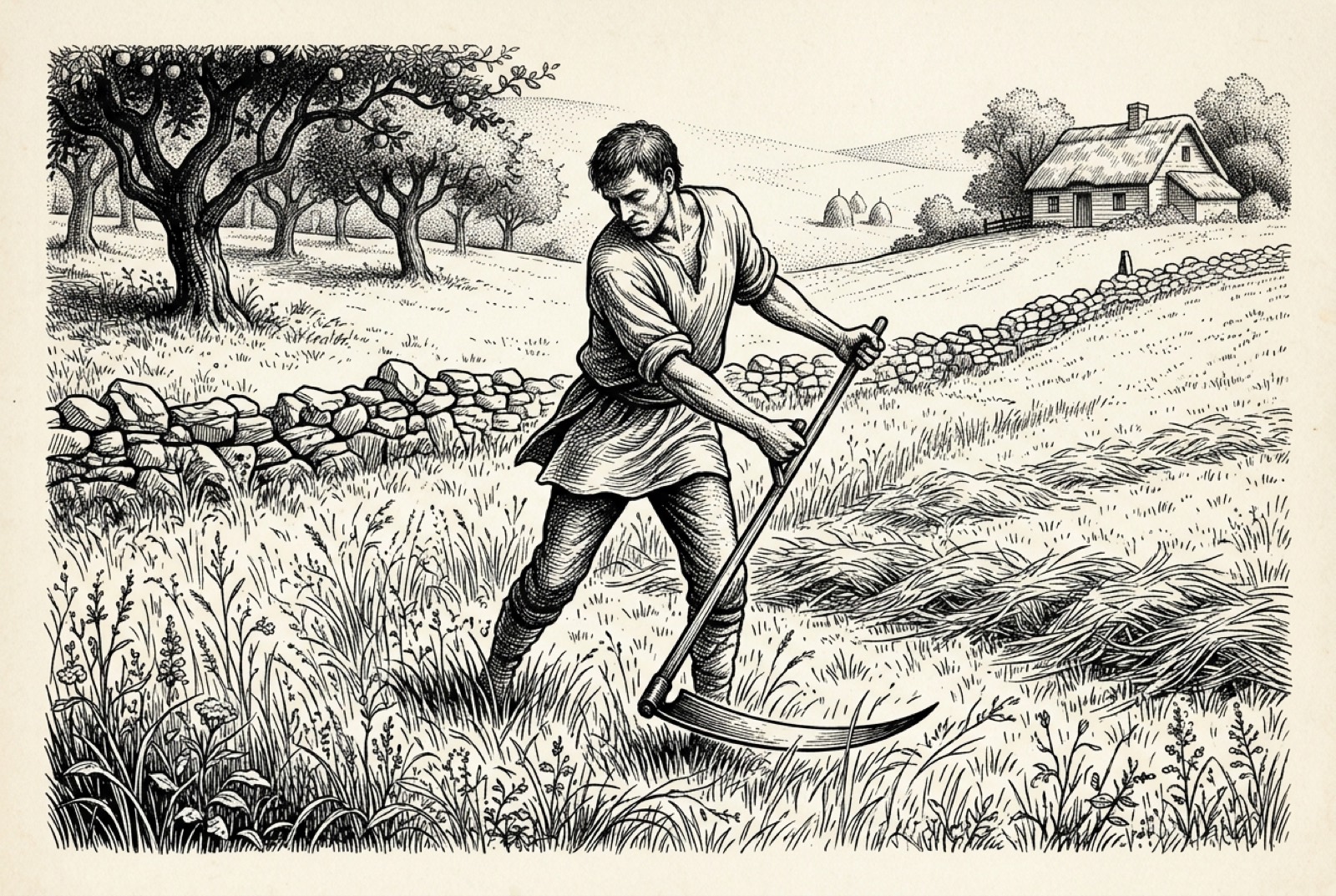
The frost came in the night, and Peter Hale knew it before he opened his eyes. The house had gone quiet the way it did when the stove burned down to coals and the heat pump gave up for the hour. He lay still and listened. Wind in the maples. One of the goats complaining. Down the hall, the floorboard outside his daughter’s room had creaked for a hundred and forty years, and if he had any say in it, it would creak for a hundred and forty more.
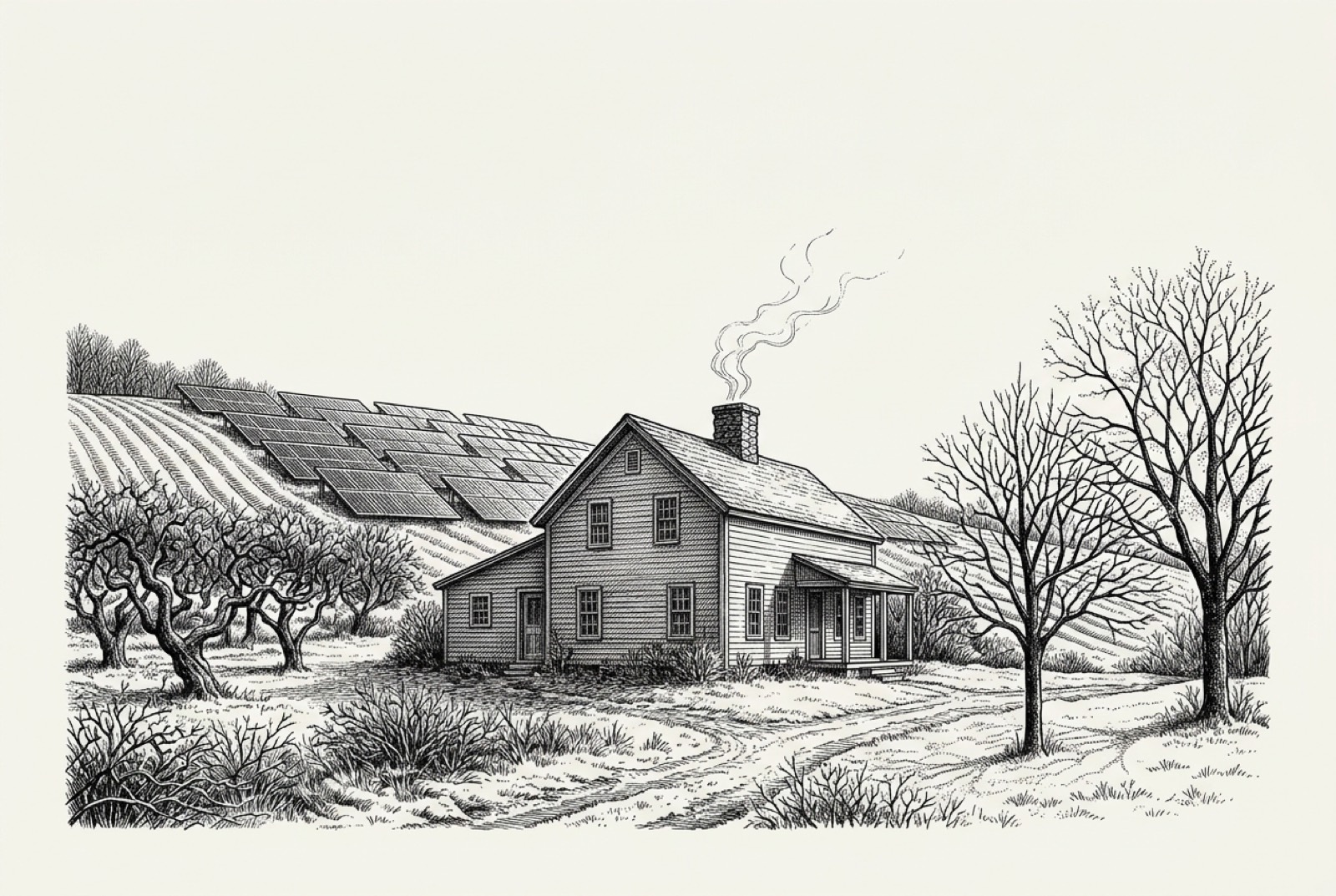
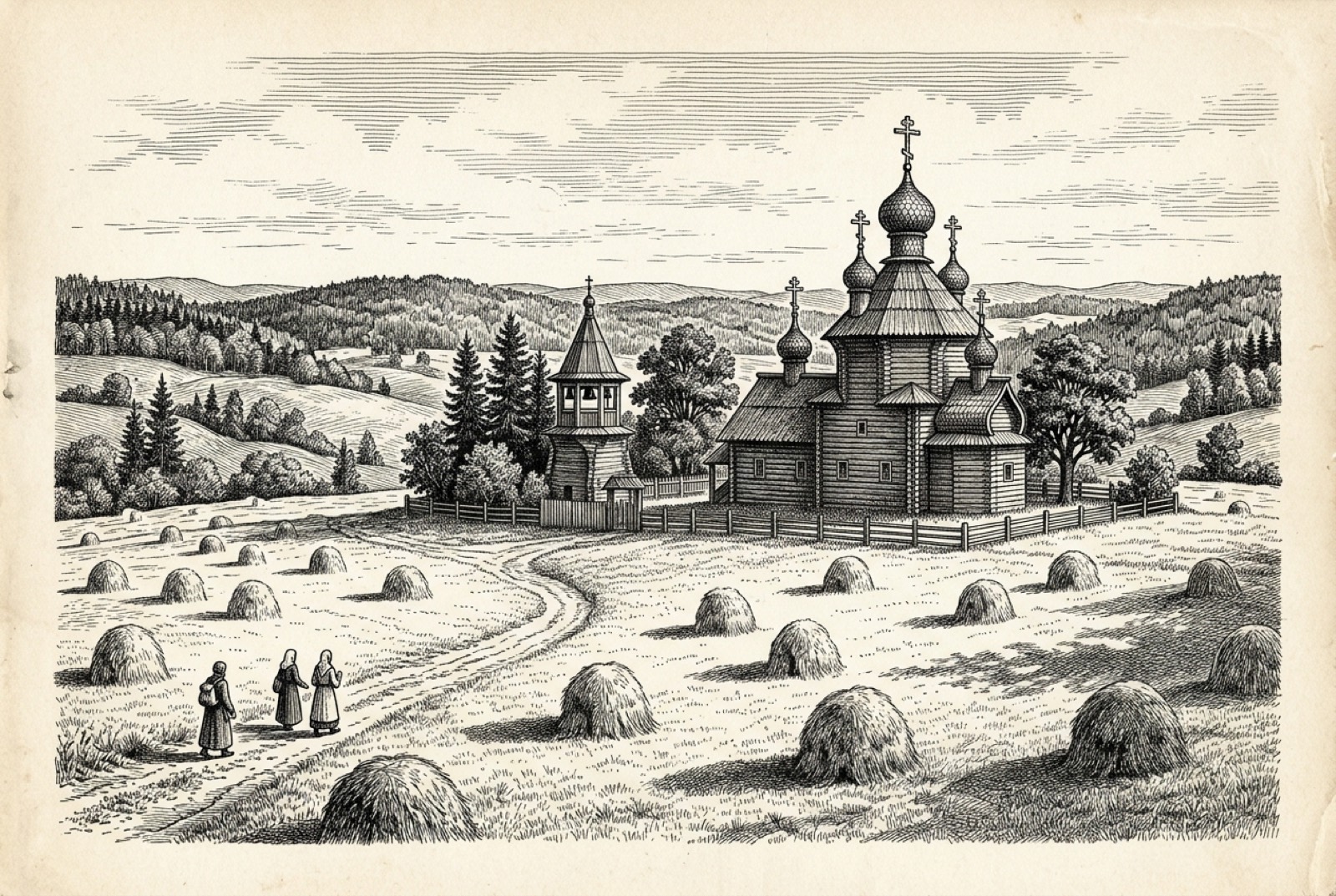
He went down in his socks, fed the stove, and stood at the kitchen window while the kettle worked. The valley was white up to the tree line. Across the road the sun had found the Mercers’ barn roof, and it steamed. Beyond it, on the south slope, the cooperative’s array lay in long dark rows, as if someone had planted the field with a crop nobody had a name for yet.
He owned this house. Twenty years on, some mornings the fact still hit him like news. He owned the house and the thirty-one acres under it. He owned the orchard Anna had pruned back from wildness, and the workshop where the smell of linseed oil never quite left the rafters, and a twelfth share in the array on the hill and the batteries buried under it. Nobody held a note on any of it. When he died it would pass to Sophia and Joseph and Xenia, and if they had the sense he prayed they had, they would keep it.
The county weekly had come on Thursday and was still lying unread on the bench by the door. He poured his coffee and opened it. There was a fight over a culvert out on the county road, a notice that the Naples learning commons needed someone to teach geometry on Tuesdays, and the time for Saturday’s pressing at the Mercers’. Below the fold, picked up from a wire service, ran a short item from California. Halverson Partners, the last of the old Sand Hill Road venture firms still raising money from outside investors, would return its remaining capital and close. Its founder, Arthur Halverson, was eighty-one. The paper printed one sentence from his final letter to investors: We can no longer find anything to buy that is worth what it would cost to own.
Peter read the sentence twice. Then he put the paper down, and for no reason he could name he thought about the parking garage.
It was in Buffalo, under an office building on Main Street, where in the spring of 2026 he had worked for a litigation support firm. He was thirty-four. All day he sat in a windowless room with forty other people, every one of whom had been promised that a paralegal certificate or a law degree was the price of a decent life, and he marked emails as privileged or not privileged for thirty-one dollars an hour. He owed seventy-one thousand dollars on the degree that had qualified him to do it. Anna worked nights at Buffalo General. They rented the upper flat of a double in Kenmore, and they had stopped saying out loud how many years it would take to save a down payment, the way a family stops saying the name of someone who has died.
On the morning the firm announced that document review would be “consolidated into a supervisory model,” he sat in his car on level three of that garage for forty minutes with the engine off. He didn’t cry. He did the arithmetic: the rent, the loan, the car, Sophia’s daycare, the number of weeks the savings account could cover. He remembered the sodium lights, the oil stain the shape of Ohio in the next space, and a yellow sign that read MAXIMUM CLEARANCE 6’8”. He remembered thinking that it was a strange thing to have measured so carefully, the space a person could fit through.
He had believed that morning, like nearly everyone, that he was watching the end of something, and he had been right, though not about what was ending.
Xenia came down first, already dressed, with her Greek under her arm. She was twelve and took herself seriously in the way twelve-year-olds can afford to when nothing they love has been taken from them yet. She set the tablet against the sugar bowl and started arguing with it about the genitive absolute. Peter listened with half an ear. The tutor never gave her the answer. It asked her what the sentence would mean if the clause were removed, then what it would mean if the clause were a reason and not a time. She hated this and loved it. Twenty years earlier the same kind of machine had cost him his job. Now it was patiently teaching his daughter Xenophon on the kitchen table, and he still didn’t know what to feel about that, so most days he felt nothing about it.
Anna came in from the barn with the milk pail and cold air in her coat. He showed her the paper.
“Should we feel sorry for him?” she asked.
“I don’t know,” Peter said. “I think we might owe him something.”
She raised an eyebrow, which was her way of asking him to finish the thought. He couldn’t. Halverson’s kind of money had paid for the machines that took his job in Buffalo, and years later, by roads nobody planned, the same machines had helped pay for this kitchen. He didn’t know how to say that without sounding like he was thanking the man.
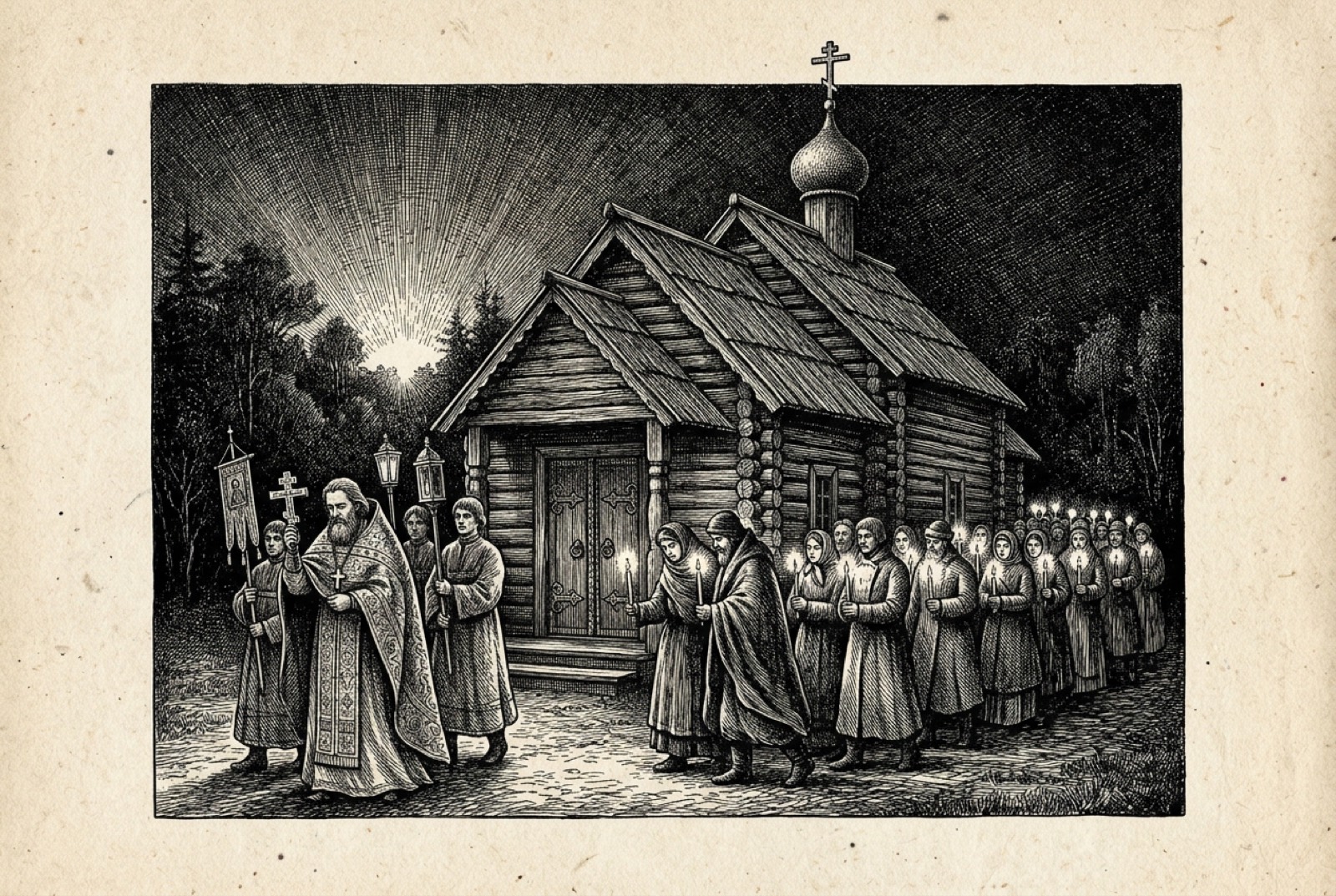
Joseph thundered down the stairs wanting to know whether he could run the press on Saturday, and the moment passed. They stood before the icon corner, where the lampada had burned all night in its red glass, and sang the Our Father together, Joseph a half-beat behind as always. Peter crossed himself right to left. He had learned that at thirty-six, two years after the garage, coming into the Church by a road he still couldn’t fully explain. Anna had been born into it, in a Carpatho-Rusyn parish in Binghamton, and her grandmother used to say the first hard frost always came near Pokrov, the feast of the Protection, when the Mother of God spread her veil over the world. The parish in Canandaigua, the county seat twenty miles north, had kept the feast two days before. The old woman had usually been right. Through the window the frost was already going off the orchard grass in long shadows shaped like the trees.
He didn’t trust his good fortune much. Some nights he thought about the Kowalczyk boy from down the valley, who had gone to the city at nineteen and now lived in one of the managed residences on the edge of New York City, where the rent was nothing and the food was good and nobody seemed to want anything at all. And some nights he wondered whether owning the land had made him a better man or only a better-fed one.
What follows is how a man like Peter Hale came to own his house, and how the heights came down. Nobody gets saved by any of that. Salvation has a different author, and we’ll come to Him at the end.
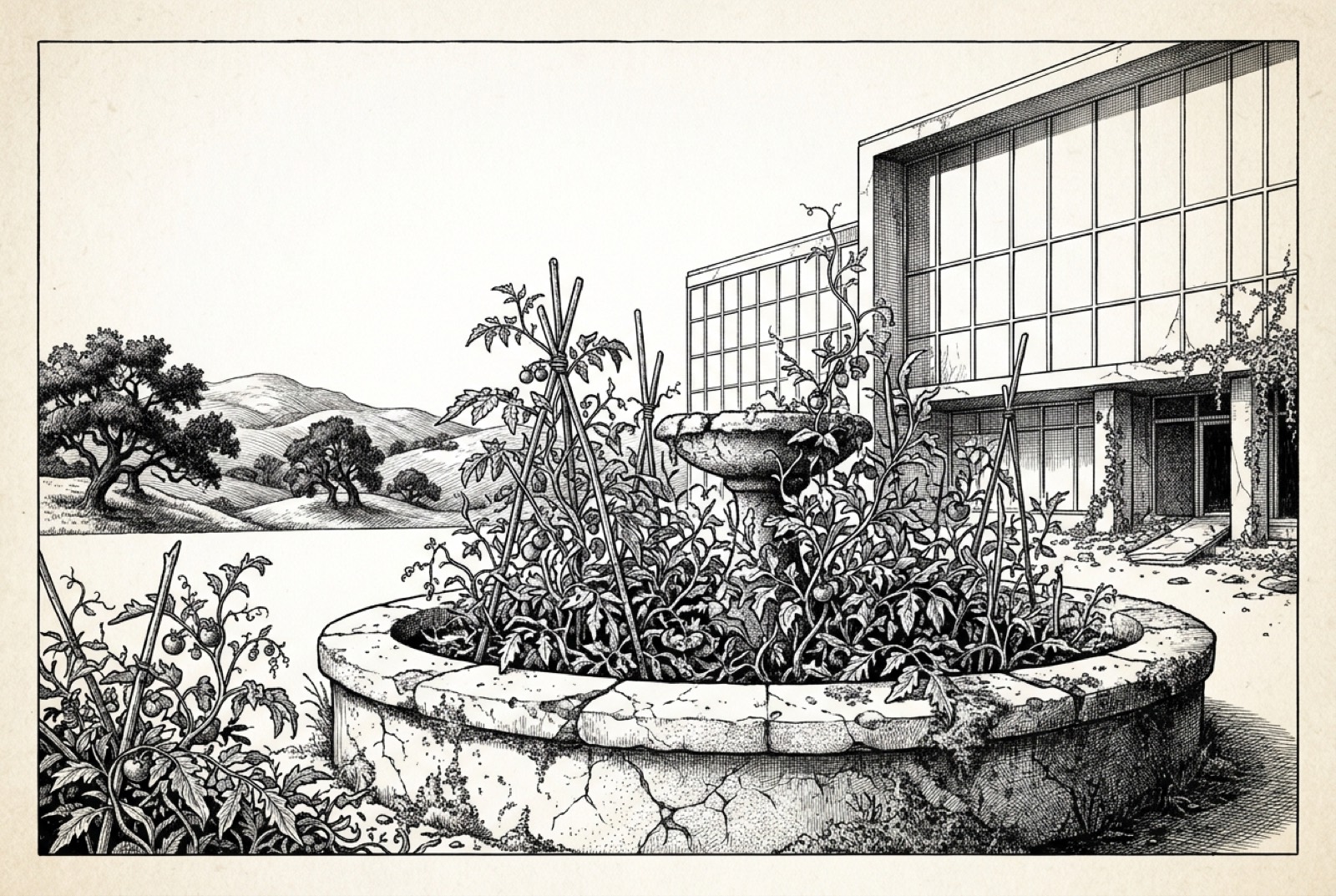
Arthur Halverson signed the last distribution on a Tuesday afternoon, in an office on Sand Hill Road that had once held sixty people and now held four. The building’s owners had stopped running the fountain in the courtyard years before. Someone had planted tomatoes in it.
He had financed two of the companies whose models sat at the frontier in 2027 and a dozen whose names nobody remembers. He had sat through the meetings in which grown men discussed spending a hundred billion dollars on a single data center as calmly as farmers discussing seed. In the years of the great buildout he believed what nearly everyone with money believed: that the intelligence revolution would be the largest transfer of value in human history, and that it would flow to whoever owned the narrow places it had to pass through.
He liked to quote a line from an essay that circulated that autumn, written by Will Manidis and Joe Roberts: “One either owns the rails or pays those who do.” He had it printed on the cover of his 2027 letter to limited partners. It seemed to him the plainest truth he had read in a decade.
He had believed, without ever having read Dostoevsky, the whole creed of the Grand Inquisitor: that human beings will always trade their freedom for bread, and will kneel to whoever holds the bread. He was not wrong about people. He was wrong about bread.
Between 2026 and 2045, roughly this happened. The models got out, first as open weights a generation behind the frontier and then, for most of the work most people needed done, not behind at all. The price of thinking fell toward the price of electricity, and then the price of electricity fell. Courts and legislatures, slowly and against fierce lobbying, began treating the new chokepoints the way their grandparents had treated railroads and telephone lines, as common carriers with duties to the public. And the customers left, mostly by going around the tollbooths instead of storming them.
Halverson saw it before most of his peers, which is the only reason his firm lasted as long as it did. By 2038 he was investing in cooperatives, which his younger partners considered a form of senility. By 2042 there was nothing left he could buy at a price that left room for the returns his investors expected. Venture capital had always been a wager on scarcity: find the thing everyone will need, and get there before it’s cheap. Then the things everyone needed kept getting cheap before anyone could get there first.
He drove home that evening down Alpine Road. His grandson was in the garage with two friends, building something with a lathe and a model that ran on a machine the size of a hardback book. Halverson asked what it was. A pump, the boy said, for a friend’s family’s irrigation in the Central Valley. Was he going to raise money for it? The boy looked at him with honest bewilderment. Why would he need money? He had the lathe.
Halverson stood in the doorway a while, an old man in a good coat watching three teenagers make something useful without asking anyone’s permission, and he understood that the world he had helped to finance had no further use for him, and he was surprised to find he didn’t mind much.
On October 29, 2026, Will Manidis and Joe Roberts published The Commanding Heights, a long essay about who would end up owning the intelligence age.1 Its argument, briefly, is that the wealth created by machine intelligence will not accrue chiefly to the laboratories that build the models. It will accrue to whoever controls the scarce positions through which intelligence has to pass on its way into the economy: the capital, the compute, the energy, the distribution networks, the payment rails, and ultimately the sovereign power standing behind all of them. “Technological revolutions,” they write, “are almost never born where they ultimately create wealth.”2 The essay opens with Ravi, a back-office worker in Bangalore, the kind of man to whom the future happens.
Much of what they describe was already visible when they wrote it. The capital commitments were real. The dependence of ordinary retirement savings on the continued growth of a few companies was real. The displacement of clerical and professional labor had begun. Peter Hale’s morning in the parking garage is invented, but thousands of mornings like it were not. If the question is which way capital was flowing in 2026, Manidis and Roberts are right.
I don’t think it has to keep flowing that way.
“The commanding heights” entered modern politics through Lenin, who used it in 1922 to defend his New Economic Policy. The Bolshevik state would allow small traders and peasants a measure of private enterprise, he argued, as long as it held the commanding heights of the economy: heavy industry, banking, foreign trade.3 Seventy-six years later Daniel Yergin and Joseph Stanislaw borrowed the phrase for a history of the late twentieth century, and the story they told ran the other way: governments across the world relinquishing the heights they had seized, selling off the steelworks and the railways and the telephone monopolies.4 So the phrase was coined by a man who wanted the state to hold the heights, then borrowed for a book about states letting them go.
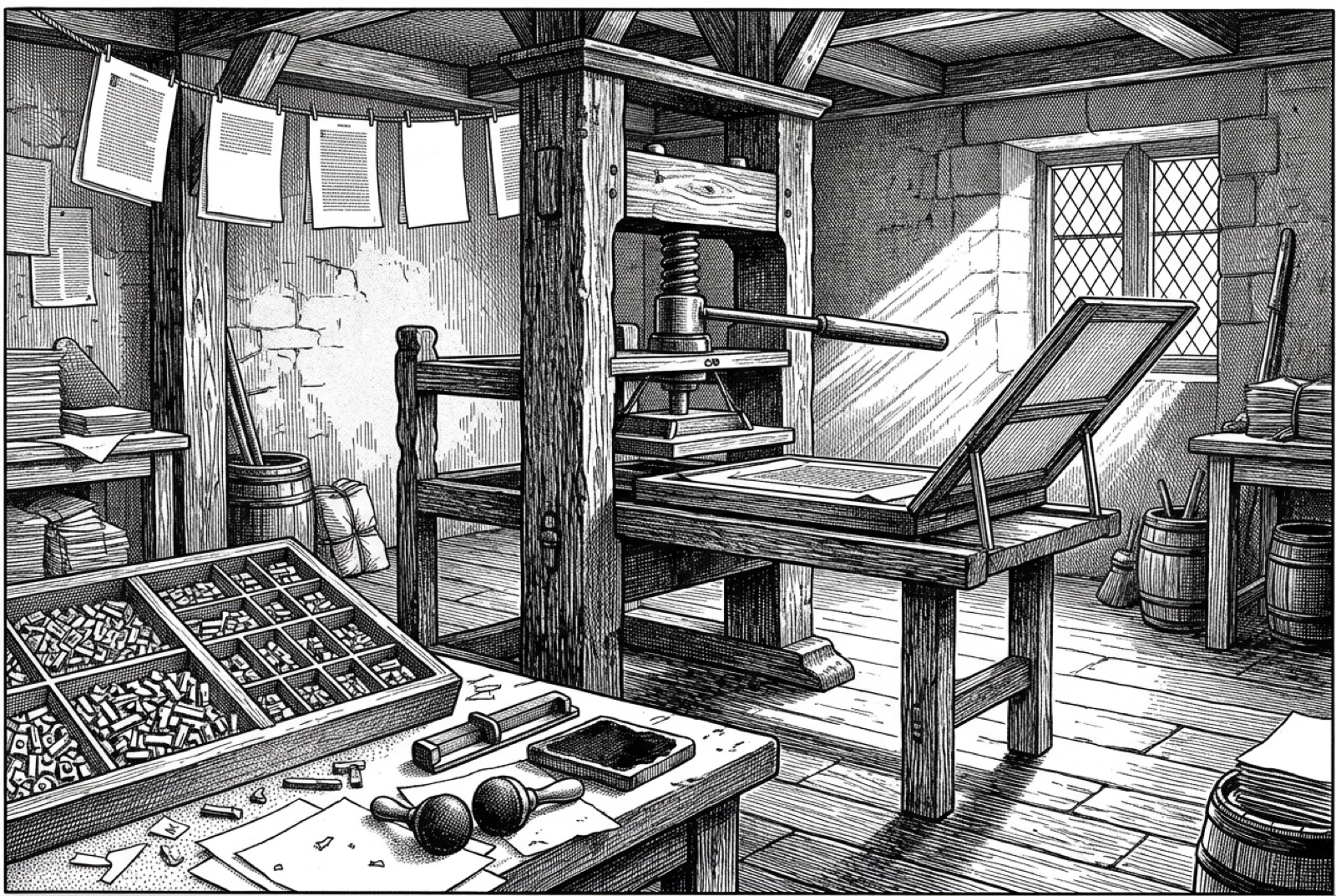
Manidis and Roberts root their argument in history. The inventors of transformative technologies, they observe, rarely capture the rewards. One of their examples is Gutenberg. In 1455 his financier, Johann Fust, sued him for repayment of loans and took possession of much of his printing equipment.5 The man who gave Europe the printing press died without much of anything.
But keep reading the history past 1455. Within fifty years presses were running in more than two hundred European towns.6 The wealth of print did not stay with Fust, either. It spread across thousands of small printers, booksellers, and paper mills, and its largest return wasn’t counted in money at all. It was counted in literacy, in vernacular Bibles, in pamphlets that no bishop or prince could suppress fast enough. The press began as a commanding height and within two generations it was a tool that anyone with a little capital and a lot of nerve could set up in a back room.
The railroads tell the same story more slowly. They did concentrate staggering wealth and power, exactly as the essay says. Then American farmers, who had been bled by freight rates for a generation, organized, and the country answered. The Interstate Commerce Act came in 1887 and the Sherman Act in 1890. In 1911 the Supreme Court broke up Standard Oil.7 None of this was quick or clean, and none of it happened on its own. People who had been made to pay at the tollbooth decided, through their legislatures and their courts, that the tollbooth was a public matter.
So there are two patterns here. Whoever controls the bottleneck gets the first fortunes, and Manidis and Roberts are right about that. Then, given time and pressure, free societies tend to pry the bottleneck open, and a technology that looked like a monopoly at birth ends up as a tool. Their essay is about the first decade. I’m betting on what comes after.
I think their essay makes three mistakes.
The first is about scarcity. Every commanding height is a bet that something will stay scarce. The essay’s own figures show the ground moving: by its count, the cost of training frontier models was rising several-fold a year while the price of using them was falling by nearly half every quarter.8 The authors take this as evidence that value would migrate away from the models and toward distribution, and they may be right about the first step. But distribution is not a law of physics. It is code, contract, and habit, and all three can be rewritten. Email was once a set of rival walled gardens. So was the web. Both ended up running on open protocols, and no company’s generosity had much to do with it.
The second mistake is about who gets to act. In The Commanding Heights, capital acts and states act, and everyone else is acted upon. Ravi doesn’t get to decide anything. Hilaire Belloc saw a version of this in 1912. In The Servile State he warned that industrial society was drifting toward an arrangement in which the many would be guaranteed security in exchange for permanent dependence on the few who owned the means of production.9 Read side by side, The Commanding Heights is Belloc’s warning with better data. What it leaves out is Belloc’s remedy, which is also Chesterton’s and, much earlier, the Hebrew prophets’: that property can be spread out again, deliberately, by law and custom, so that ordinary families own the things they live by.
The third mistake is about what an economy is for. Underneath the analysis is an unspoken premise: that the purpose of the intelligence revolution is to produce value, and that the only interesting question is who captures it. I don’t think the premise is cynical. I think it leaves things out. An economy is a means. It exists so that people can feed their children and raise them well, so that they can work at something worth doing, pray, rest, and die in their own beds. Any account of the future that forgets this will misjudge what people do when the machines arrive, because people have never been content to be inputs.
In the story that follows, the heights come down for four reasons: intelligence gets too cheap to fence in, energy follows it, the law catches up to power as it has before, and enough ordinary people decide to own things again instead of renting their lives from someone else. The machines’ good intentions aren’t one of the reasons. Machines don’t have any.
None of it is inevitable. Abundance carries its own tyrannies. Huxley imagined a world that controlled people through comfort rather than scarcity, and the managed residences around New York City, which come later, are his warning taken seriously. Dostoevsky’s Grand Inquisitor still has an argument to make. A world without hunger isn’t a world without sin, and a civilization that solves the problem of bread has only cleared the ground for harder questions.
The pessimists have had the floor for a while. What follows is my answer, and it starts with a file that got loose in March 2023.
Notes
Will Manidis and Joe Roberts, The Commanding Heights, published October 29, 2026, https://commanding-heights.com/. [VERIFY: publication date and the summary of the thesis against the full original text.]↩
Ibid. [VERIFY: exact wording; this quote and the “rails” line in the Prologue came from an automated summary of the page and must be checked word for word before publication.]↩
Lenin’s defense of the New Economic Policy, commonly dated to his report to the Fourth Congress of the Communist International, November 1922. [VERIFY: exact speech and wording of the “commanding heights” passage.]↩
Daniel Yergin and Joseph Stanislaw, The Commanding Heights: The Battle Between Government and the Marketplace That Is Remaking the Modern World (Simon & Schuster, 1998). ↩
The Helmasperger Notarial Instrument (November 1455) records the court proceedings in Fust’s suit against Gutenberg. [VERIFY: extent of the equipment transferred; scholars disagree on how much Gutenberg retained.]↩
Common estimates put printing in roughly 250 European towns by 1500. [VERIFY: choose a cited figure, e.g. from Febvre & Martin, The Coming of the Book, or the Incunabula Short Title Catalogue.]↩
Interstate Commerce Act (1887); Sherman Antitrust Act (1890); Standard Oil Co. of New Jersey v. United States, 221 U.S. 1 (1911). ↩
Figures as reported in The Commanding Heights: training costs rising roughly 3.5x per year, token prices falling roughly 47% per quarter. [VERIFY against the original and its sources.]↩
In March 2023, a little more than a week after Meta began handing out the weights of its LLaMA language model to approved researchers, someone posted a download link on 4chan.1 Within days the model was running on gaming computers and, slowly, on laptops. The company had meant to share it with a few thousand academics. It ended up shared with the world.
Nothing much happened, at first. The leaked model was clumsy by the standards of the systems behind the big companies’ walls, and the people who mattered treated it as a curiosity. Two years later, in January 2025, a Chinese laboratory called DeepSeek released a reasoning model with open weights that performed close to the best American systems and had reportedly been trained for a fraction of the cost. On the next trading day, Nvidia lost close to six hundred billion dollars in market value, the largest one-day loss for any company in American history to that point.2 Markets recovered, but the lesson stuck.
The lesson was that intelligence leaks, for reasons that have little to do with anyone’s intentions. A model’s weights are a file. Once a capability has been shown to be possible, the second team to reach it pays less than the first, and the third pays less than the second. Engineers move between companies and take what they know with them. Researchers publish, because publishing is how they are paid in the currency they care about. Nations that lose a race have every reason to give away the second-place prize, because a free product does more damage to a rival’s margins than an expensive one does.
The Commanding Heights knows all of this. Its authors’ answer is that the leak doesn’t matter, because the value was never going to sit in the models anyway. It would sit downstream, in distribution, in payment, in the sovereign’s protection. I think the escape matters for a different reason, which is what it put in ordinary hands.
In the winter of 2028, Peter Hale spent most of his weekday mornings at the downtown library in Buffalo, because the library was warm and free and nobody there asked him what he did for a living. He had been out of steady work for nearly two years. He drove for a delivery service three evenings a week and picked up contract jobs when he could find them, which was less and less.
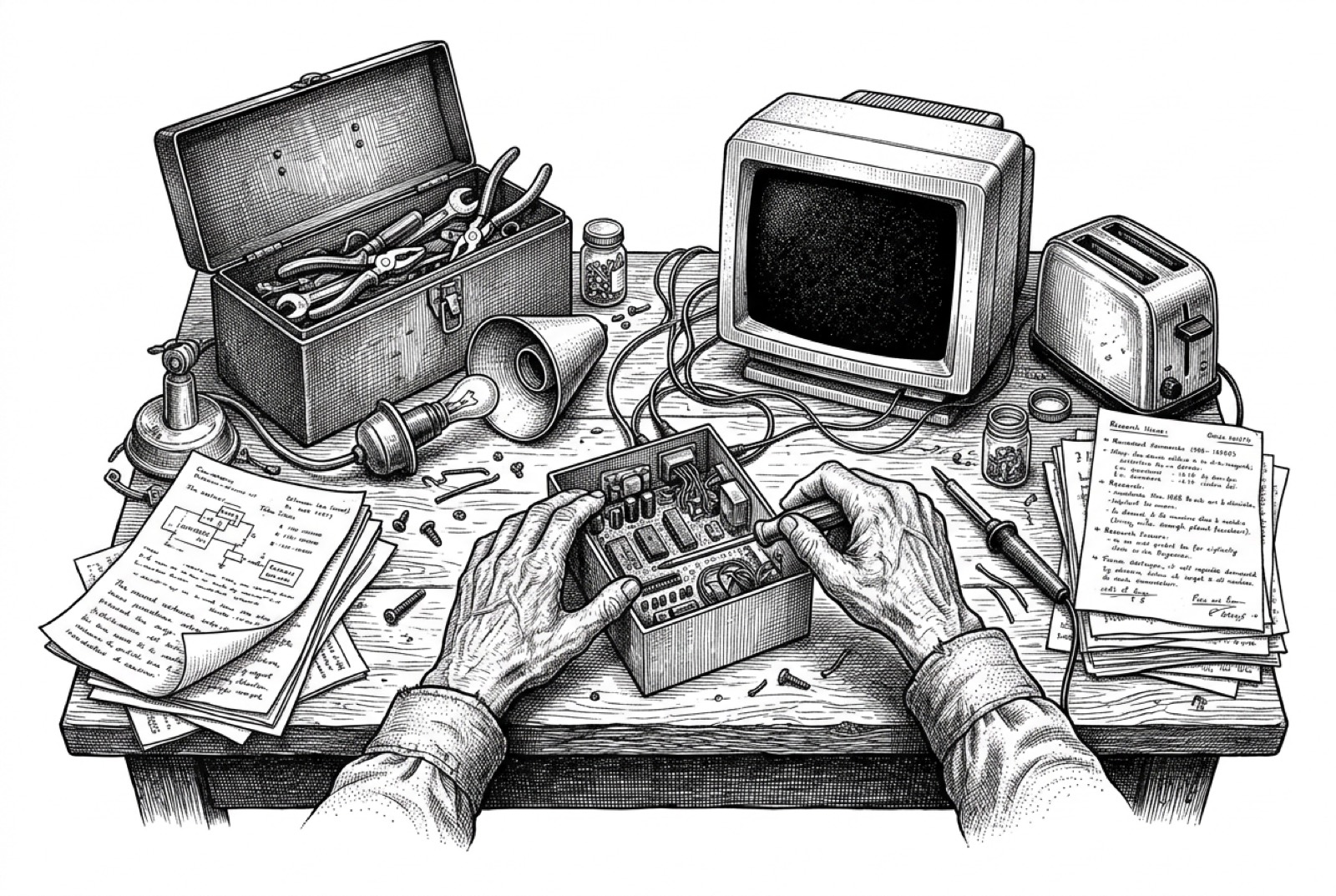
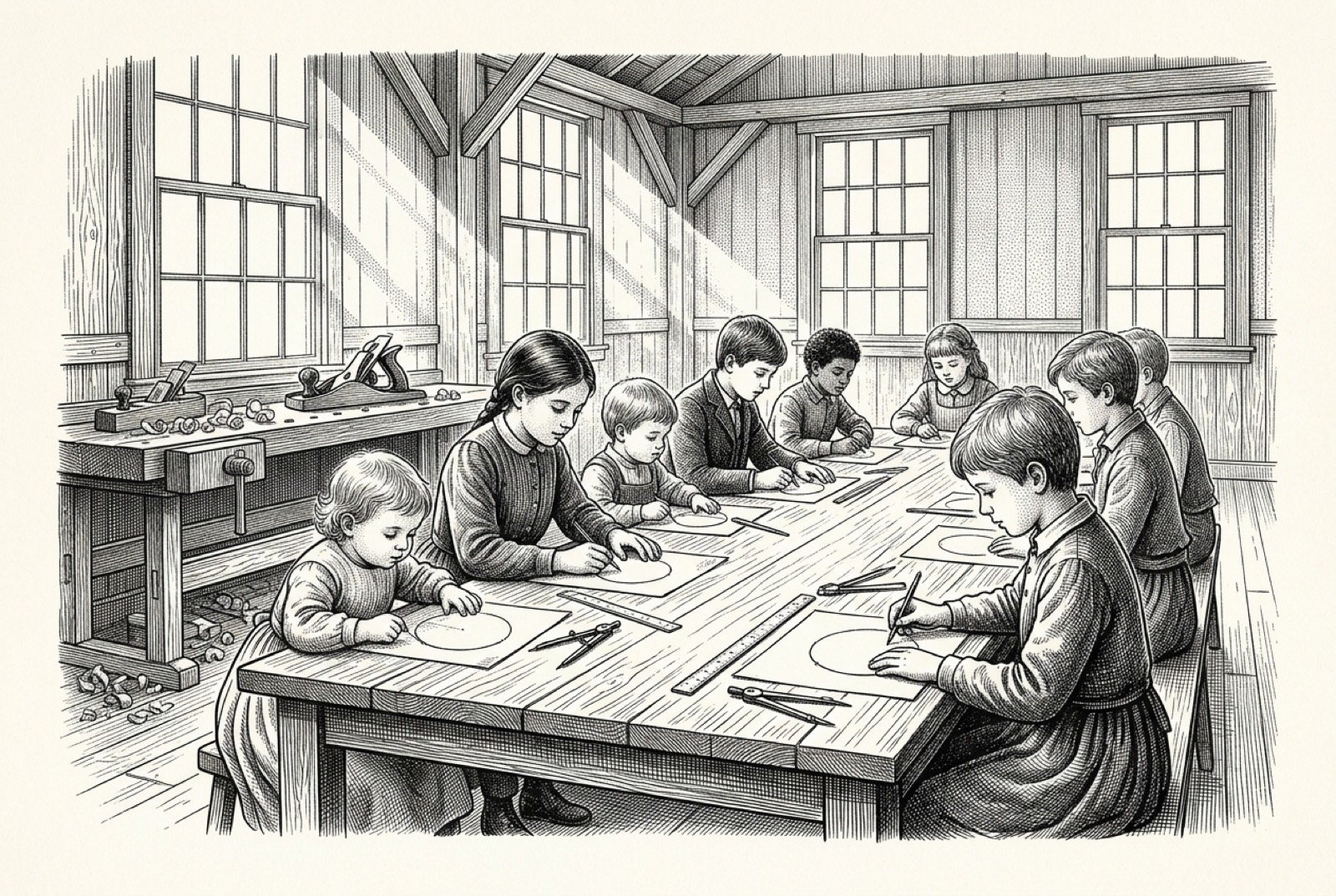
On Thursdays a retired electrical engineer named Walter Okafor ran something the library called a repair café in the community room. People brought toasters and lamps and broken phones, and Walt and two other old men fixed them, or taught them to fix their own. One morning Peter wandered in to get out of the noise of the children’s section and found Walt hunched over a gray box the size of a shoebox, wired to a monitor with a cracked bezel.
“What’s that one?” Peter asked.
“That,” Walt said, “is a lawyer.”
It wasn’t, of course. It was a used workstation Walt had bought at a university surplus auction, running an open model that a volunteer foundation had trimmed and tuned to fit inside it. But a woman from Black Rock had brought in her eviction papers that morning. The box had read them, compared them to the state’s housing statutes, and noticed that her landlord had served the notice by the wrong method. Walt had printed the explanation and the relevant section of the law and sent her down the street to legal aid with it in her hand.
“Doesn’t phone home,” Walt said. “Doesn’t need permission. Doesn’t sell her anything. Doesn’t care if she can pay.” He patted the box as if it were a dog. “Ivan Illich would have loved this thing.”
Peter had never heard of Ivan Illich. That night he looked him up.
Illich was a Catholic priest born in Vienna in 1926, an unruly man who spent much of his life in Mexico arguing that modern institutions had a way of disabling the people they were meant to serve. In 1973 he published a short, strange book called Tools for Conviviality. In it he distinguished between two kinds of tools. Convivial tools are ones that people can use, as he put it, “to accomplish purposes chosen by the user.” A hammer, a bicycle, a library, a telephone are convivial. Manipulative tools are the other kind: tools so large, so expensive, or so complex that they can be operated only by specialists and institutions, and which end up shaping their users more than their users shape them.3 Illich thought that every technology passed through a first watershed, at which it really did help people, and then reached a second watershed, after which it began to make them dependent. Medicine crossed it, he thought, when it began to treat ordinary life as a disease. Schooling crossed it when it taught people that learning was something only a school could give them.
Artificial intelligence in 2026 had already reached the first watershed and was racing toward the second. The frontier systems were rented, not owned. They lived in data centers that cost more than cathedrals. Their makers could change them, censor them, raise their prices, or switch them off. A small business that built itself on one of them was a tenant, and a tenant’s lease can always be renegotiated by the landlord. The authors of The Commanding Heights saw this clearly, and they were right that it was the shape of the market. What they treated as the destination, Illich would have called a fork in the road.
In the years after 2026 the world took the other branch, for three reasons, none of them pure.
The first was cost. Every year after 2026 the open models trailed the frontier by a little less, and every year the hardware to run them grew cheaper. By the early 2030s a model that could read a contract, tutor a child in algebra, diagnose a failing irrigation pump, or draft a county budget could run on a machine a family could buy outright, the way an earlier generation bought a refrigerator. The frontier labs kept their lead at the very top. The very top turned out to matter less than anyone had expected for most of what people actually needed done. A farmer doesn’t need a system that can prove new theorems. She needs one that can read a soil report.
The second was governance. Open software had already shown that a commons could be maintained without an owner. Linux, which runs most of the world’s servers, has been stewarded for more than three decades by a loose federation of companies, foundations, and volunteers.4 The open model foundations of the late 2020s built on that example. They were chartered as nonprofit trusts with published constitutions. Their boards included engineers, but also representatives from libraries, cooperatives, universities, and, eventually, churches. They argued in public about what their models should and should not do. The arguments were slow and often bitter, and they produced models that no single company or government could quietly bend.
The third was refusal. Enough people declined to rent their thinking from someone else once they had a choice. Economists are bad at forecasting this because it never shows up in a cost curve. It looked like Walt in the library basement, or Halverson’s grandson at the lathe, or a county clerk in Ontario County who, in 2031, got tired of paying a software vendor nine hundred thousand dollars a year and, with two volunteers and an open model, rebuilt the county’s records system over a summer.
The escape had costs.
The same open models that helped the woman from Black Rock fight her eviction helped others write convincing scams at a scale no boiler room could match. Some families lost their savings to voices on the phone that sounded exactly like their sons. Researchers warned, correctly, that capabilities useful for designing medicines could also be useful for designing poisons.
Locking the models back up was impossible by then, so the response was to draw narrower, firmer lines. The danger usually lay less in the intelligence than in the physical capacity to act on it: the synthesis equipment, the controlled materials, the laboratory. Those remained regulated, licensed, and inspected, as they had been before, with treaties among the major powers to keep it that way. Fraud became something people learned to defend against, as they had learned to defend against forged checks and phishing emails, with new habits, new verification, and new laws. It wasn’t enough. It still beat handing the only keys to a handful of companies and hoping they stayed honest.
C. S. Lewis would have pressed on a deeper cost. In The Abolition of Man, written in 1943, he warned that each new power won by “Man” over nature turns out, on inspection, to be a power exercised by some men over other men, with nature as the instrument.5 Distributing the power widely doesn’t abolish that danger. It multiplies the number of people who have to be good. A society of small owners with powerful tools is freer than a society of tenants. It isn’t wiser, unless its people become wise. Intelligence answers the question how. It has never been able to answer the question why, and the machines of the 2030s could tell you the most efficient way to do almost anything without being able to tell you whether you should.
Walt Okafor understood this, in his way. Years later, when Peter had his own box in his own workshop, he remembered what Walt said when someone at the repair café asked whether the machine would ever be smarter than people.
“Smarter, sure,” Walt said. “It already knows more law than any of us. But it’ll never be better than us. It’s never had to be.”
Notes
James Vincent, “Meta’s powerful AI language model has leaked online,” The Verge, March 8, 2023. [VERIFY: timeline between Meta’s controlled release (Feb 24, 2023) and the leak.]↩
DeepSeek released R1 on January 20, 2025. Nvidia’s market value fell roughly $590 billion on January 27, 2025. Reported widely, e.g. Reuters and Bloomberg. [VERIFY: exact figure and “largest one-day loss” claim.]↩
Ivan Illich, Tools for Conviviality (Harper & Row, 1973). [VERIFY: exact wording of quoted phrase.]↩
The Linux kernel was first released in 1991; it is now maintained under the Linux Foundation with contributions from thousands of developers and hundreds of companies. ↩
C. S. Lewis, The Abolition of Man (1943), ch. 3, “The Abolition of Man.” Paraphrased; the original reads approximately: “what we call Man’s power over Nature turns out to be a power exercised by some men over other men with Nature as its instrument.” ↩
Peter built his own box in the spring of 2030, from parts Walt helped him scavenge, and the first thing he asked it to read was his debt.
It took him most of a weekend to collect the paperwork. Nine years of statements from three different loan servicers, because his loans had been sold twice. The promissory notes he had signed at twenty-three without reading. Letters about forbearance, letters about deferment, letters thanking him for his payment and informing him that his payment had been applied to interest. He scanned it all at the kitchen table in Kenmore while Anna slept off a night shift, and fed it to the machine, and asked it a question no one at the loan company had ever answered to his satisfaction: Why do I owe more now than I borrowed?
The answer took four minutes and ran to eleven pages. Most of it was arithmetic, the slow compounding of interest during the years he had been steered into forbearance instead of an income-based plan he had qualified for the entire time. Some of it was worse. Fourteen months of payments, made on time, had been credited late, and the late fees had been capitalized into his principal. A transfer between servicers had reset the count of qualifying payments toward a forgiveness program back to zero. Nobody had lied to him exactly. The system was complicated enough to hide its own mistakes, and the mistakes kept landing on the borrower’s side of the ledger.
He sat with the pages for a long time. Then he did something he had never done before, which was to send a document to the state attorney general’s office. It turned out that forty thousand other New Yorkers had sent one that spring too.
One of the oldest economic laws in the Bible is a law for cancelling debt.
“And ye shall hallow the fiftieth year,” says the Book of Leviticus, “and proclaim liberty throughout all the land unto all the inhabitants thereof: it shall be a jubile unto you; and ye shall return every man unto his possession, and ye shall return every man unto his family.”1 In the Jubilee year, land that had been sold under pressure returned to the family that originally held it. Israelites who had sold themselves into servitude for debt went free. Deuteronomy adds a shorter cycle: every seventh year, creditors were to release what they had lent to their neighbors.2 The Liberty Bell in Philadelphia carries the Leviticus verse on its shoulder. Few of the people who walk past it know it was a law about debt.
The Hebrews didn’t invent the idea. The kings of ancient Mesopotamia regularly proclaimed what they called mīšarum, an act of “righteousness” or “straightening,” that cancelled consumer debts and freed people who had been sold into bondage for them. One of the best preserved, the edict of King Ammi-ṣaduqa of Babylon from the seventeenth century before Christ, survives on clay tablets.3 In Athens around 594 BC, the lawgiver Solon enacted the seisachtheia, the “shaking off of burdens,” which cancelled debts secured on land and on persons and freed Athenians who had been enslaved for debt.4 Michael Hudson, who has written more about these decrees than almost anyone, argues that the rulers who issued them understood compound interest: debts grow faster than the economy that has to pay them, because interest compounds and harvests don’t. Left alone, debt moves a society’s land into its creditors’ hands and its people into their service.
In the Lord’s Prayer as Matthew records it, the Greek doesn’t say “trespasses.” It says opheilēmata: debts. “And forgive us our debts, as we forgive our debtors.”5 Orthodox Christians pray it at every service, and most of them, Peter included, prayed it for years before noticing it was also a sentence about money.
By 2026 the United States held roughly $1.6 trillion in federal student debt, owed by more than forty million people.6 Behind that number sat medical debt, credit card debt, auto loans stretched to seven years, and mortgages on houses that people in their thirties could no longer afford to buy. Some of this debt was the honest price of honest choices. A great deal of it was not. Over the preceding two decades, regulators and courts had repeatedly found the financial system doing to ordinary people what it had done to Peter. In 2016, Wells Fargo admitted that its employees had opened millions of accounts customers never asked for; the bank later estimated the number at about 3.5 million.7 In 2012, the country’s largest mortgage servicers paid $25 billion to settle charges that they had foreclosed on homes using forged and “robo-signed” documents.8 In 2022, the student loan servicer Navient agreed to a $1.85 billion settlement with thirty-nine states over allegations that it had steered borrowers into costly forbearance.9
Each of these cases took years to build, because finding the wrongdoing meant reading millions of pages of documents, and reading documents was slow, expensive, specialized labor. It was, as it happened, exactly the labor Peter had done in Buffalo.
When reading becomes nearly free, the economics of concealment collapse. Complexity had protected the financial system for decades, mostly without anyone planning it that way: no borrower could audit his own loan, and no regulator could audit every loan. By the end of the 2020s, every borrower could. Tens of millions of people did what Peter did at his kitchen table. The patterns that surfaced were not ambiguous, and they were not small.
What followed was a decade of litigation, legislation and settlement.
The cases came first. State attorneys general, consumer lawyers, and the remaining federal regulators found themselves with evidence assembled by the borrowers themselves, millions of individual audits that added up to a pattern no defense lawyer could explain away. Settlements in the late 2020s and early 2030s ran into the hundreds of billions. Much of that money took the form of principal reductions rather than checks.
Then came the law. In 2023 the Supreme Court had ruled, in Biden v. Nebraska, that the executive branch lacked authority to cancel student debt on its own.10 The decision was often described as the end of debt relief. Read carefully, it said something narrower and more useful: that only Congress could do it. Federal student loans were already owned by the federal government, so forgiving them required no seizure from anyone. It required a vote. The vote came in 2032, after an election in which millions of indebted voters across both parties had read their own files. The Restoration of Discharge Act did two things. It cancelled outstanding federal student debt above a modest floor and paired that with reforms to how education was financed. And it restored what Congress had taken away in stages between 1976 and 2005: the right of student borrowers, like every other debtor, to seek relief in bankruptcy court.11
Last came the slow jubilees. Private debts couldn’t be voted away, and no one seriously tried. Instead the country reached for tools it had used before. During the Depression, the Home Owners’ Loan Corporation bought and refinanced about a million distressed mortgages, on terms families could actually pay.12 A similar public refinancing authority in the 2030s bought troubled mortgages at their market value and rewrote them. Charities, churches, and eventually county governments did with medical debt what a small nonprofit had been doing since 2014, buying it in bulk for pennies on the dollar and then forgiving it.13 The creditors took real losses, but they took them through bankruptcy courts, settlements, and sales, under rules written in advance. No one’s property was confiscated, which is a large part of why the settlement held.
Peter’s balance reached zero in March 2033. He found out from a letter. Anna was driving when he opened it, and when he read it aloud she pulled the car onto the shoulder of Route 33 and put her forehead on the steering wheel and cried. He had sat in a parked car once before, doing arithmetic. This time there was no arithmetic left to do.
The objections to all this were loud at the time and some of them were right.
The first was fairness. Millions of people had paid off their loans by working second jobs, living with their parents, choosing cheaper schools or no school at all. What did the Jubilee say to them? At first it said nothing satisfying. The best answer anyone gave, was that the alternative to an imperfect jubilee was not a fair system. It was the existing system, and the existing system had been running on hidden unfairness for decades. That answer persuaded some people. It never persuaded all of them, and the resentment it left lasted a generation.
The second objection was moral hazard. If debts could be forgiven once, wouldn’t everyone borrow recklessly, waiting for the next jubilee? Leviticus has an answer of sorts. The Jubilee was never a surprise; it was scheduled. Everyone knew the land would revert in the fiftieth year, and so the price of land was set by the number of harvests left before it did.14 The law kept debt from becoming permanent without making it meaningless. The reforms of the 2030s worked the same way. Restoring bankruptcy protection for student loans made lenders care again whether a degree could be repaid, and the price of degrees began, for the first time in two generations, to fall.
The third objection came from inside the Church. In Matthew’s gospel, Christ tells the story of a servant whose master forgives him an enormous debt, ten thousand talents, more than he could earn in many lifetimes. The servant walks out and finds a fellow servant who owes him a hundred denarii, a few months’ wages, and has him thrown into prison until he pays. When the master hears of it, he is furious. “Shouldest not thou also have had compassion on thy fellowservant, even as I had pity on thee?”15
The parable is a warning, and it applied to the forgiven more than to the forgivers. A country that had been released from its debts now had to decide whether it would release others: the tenant behind on rent, the neighbor who owed for hay, the brother-in-law who never paid back the loan for the truck. The machines could read every contract on earth and couldn’t make anyone merciful. Some of the forgiven turned out to be generous. Some of them, like the servant in the story, turned out to be harder creditors than the banks had ever been.
Peter thought about the parable often in later years, usually when he was owed money. He didn’t always pass. When he failed, he usually thought of Route 33 afterward.
Notes
Leviticus 25:10 (KJV). The phrase “Proclaim liberty throughout all the land unto all the inhabitants thereof” is inscribed on the Liberty Bell. ↩
On mīšarum edicts and the Edict of Ammi-ṣaduqa (c. 1646 BC, middle chronology), see Michael Hudson, …and forgive them their debts (ISLET, 2018). [VERIFY: date and chronology convention.]↩
Aristotle, Constitution of the Athenians 6; Plutarch, Life of Solon 15. [VERIFY: date of archonship, conventionally 594/3 BC.]↩
Matthew 6:12. Greek ta opheilēmata hēmōn. Luke 11:4 uses hamartias (sins) in the first clause. ↩
Federal Student Aid portfolio data. [VERIFY: current total (~$1.6–1.7T) and borrower count (~42–43M) as of 2026.]↩
Wells Fargo’s 2017 expanded review raised its estimate of potentially unauthorized accounts to about 3.5 million. ↩
National Mortgage Settlement, February 2012, among the federal government, 49 states, and five servicers. ↩
Navient multistate settlement, January 2022. [VERIFY: total value ($1.85B) and number of states (39 + DC?).]↩
Restrictions on discharging student loans in bankruptcy were added in the Education Amendments of 1976, expanded in 1990 and 1998, and extended to most private student loans by the Bankruptcy Abuse Prevention and Consumer Protection Act of 2005. [VERIFY: statutory sequence.] The Restoration of Discharge Act is fictional. ↩
The Home Owners’ Loan Corporation (1933–1951) refinanced roughly one million mortgages. [VERIFY: figure.]↩
RIP Medical Debt, founded 2014, now Undue Medical Debt. ↩
Optimistic futures usually start lying about energy.
Every age of technological enthusiasm has a favorite miracle. For the 1950s it was atomic power “too cheap to meter,” a phrase from a 1954 speech by the chairman of the Atomic Energy Commission that has been quoted ever since, mostly as a joke.1 For our own moment it is fusion, or room-temperature superconductors, or some other discovery that, once made, will rinse every hard tradeoff out of the world. What follows doesn’t need any of them. It’s speculation, extended from cost curves that already existed in 2026.
Here is what had already happened. Between 2010 and the early 2020s, the price of solar panels fell by roughly ninety percent. The price of lithium-ion battery packs fell by a similar amount over a similar span.2 In 2020, an artificial intelligence system called AlphaFold, built by Google DeepMind, predicted the three-dimensional structure of proteins with an accuracy close to that of laboratory experiments, solving a problem that had stumped biologists for half a century. In 2024 two of its creators shared the Nobel Prize in Chemistry.3 In December 2022, scientists at the National Ignition Facility in California produced a fusion reaction that released more energy than the lasers delivered to the fuel, the first time that had ever been done, though the facility as a whole still consumed far more power than it produced.4 In 2023, a company called Fervo Energy demonstrated that drilling techniques borrowed from the shale industry could produce geothermal power from hot rock almost anywhere, not just in volcanic regions.5
The Mercers had farmed the land across the road from what would become the Hale place since 1911. Ruth Mercer, who ran it in the 2030s with her husband, Dale, and their two grown sons, remembered the winter of 2025 as the one when the electric bill went over six hundred dollars a month for the dairy barn alone, and the co-op’s milk price went down at the same time.
“We were working to pay the power company,” she said. “And the power company was working to pay somebody in Texas.”
In 2033, the township called a meeting at the fire hall to vote on a proposal to form an energy cooperative. The proposal came from a schoolteacher, a retired lineman, and a twenty-six-year-old named Daniel Kessler, who had moved up from Brooklyn during the bad years and used an open model to design the whole system in his spare time: the array on the south slope, the storage, the interconnection with the neighboring township, the financing. Every household that joined would buy one share. The cooperative would sell power to its members at cost and sell the surplus to the regional grid.
The meeting ran three hours. Somebody’s uncle stood up and said it was socialism. Somebody else pointed out that the electric cooperatives that had wired rural America in the 1930s had been organized by farmers, with loans from Franklin Roosevelt’s Rural Electrification Administration, and that many of them were still operating, owned by their members, ninety years later.6 Dale Mercer, who almost never spoke at meetings, stood up near the end and said that he didn’t care what it was called as long as it was theirs. The motion carried, eighty-one to twelve.
In the late 2020s and early 2030s, AI systems running on public and open infrastructure began to do for materials science what AlphaFold had done for biology. The work had already begun. In 2023, DeepMind announced that a system called GNoME had predicted the structures of hundreds of thousands of stable new crystalline materials, though how many would prove useful remained in dispute.7 Over the following decade, the long, slow, trial-and-error search for better solar cells, better battery chemistries, and cheaper catalysts was compressed from decades to years. There was no single breakthrough, only a long run of small ones. Panels grew more efficient and cheaper still. Batteries moved away from scarce metals toward abundant ones like sodium and iron. Geothermal drilling became routine. Fusion, as always, remained about twenty years away, and then, by the 2040s, perhaps a little closer.
What mattered most was where energy could be made. Coal, oil, gas, and nuclear power had all favored size: big plants, big pipelines, big transmission lines, and therefore big owners. Sunlight, wind, and heat from the ground are spread out across the earth, and the technology to harvest them finally became cheap and simple enough to match. A township could own its power plant. So could a monastery or a cluster of farms. The utility survived as something more like the road department, maintaining the shared wires between thousands of small producers.
The same pattern ran through the rest of the material economy, unevenly. Machine-designed fertilizers and seeds cut the cost of growing food. Small, cheap, programmable fabrication tools let a workshop in a barn make parts that once came only from a factory overseas. Medicine got cheaper in some places and stayed stubbornly expensive in others, because the bottleneck in medicine was often not knowledge but trust, liability, and the time of skilled people, and AI could only do so much about that. Housing got cheaper only in towns that changed their zoning, and no model could do that for them.
In 1865 the English economist William Stanley Jevons observed that as steam engines became more efficient at burning coal, Britain burned more coal, not less. Cheaper energy invited more uses for it.8 A civilization with cheap power and cheap intelligence could, if it chose, use them to build ever larger machines for distraction, ever more elaborate ways to sell people things they didn’t need, ever more comfortable cages. Nothing about solar panels makes anyone wise.
And some scarcities can’t be engineered away. Land is finite. Time is finite. Attention is finite. Each person gets one life and one body, and that body will die. A child needs a particular mother and a particular father, not an abundance of caregivers. A friendship can’t be manufactured. Neither can beauty, which depends on rareness and particularity as much as on materials. The economists of the industrial age often spoke as though human wants were infinite and goods were the only limit. It is closer to the truth to say that human wants are deep, and that most of what people want most was never for sale.
Wendell Berry spent his life making this argument from a farm in Kentucky. In The Unsettling of America, published in 1977, he wrote against an agriculture that treated land as a factory floor and farmers as interchangeable parts.9 He was defending a way of living in which people stayed in one place long enough to know it, care for it, and be responsible to it. Cheap energy, in his view, had mostly been used to make that kind of life impossible: to replace people on the land with machines and send the people to the cities.
Cheap, distributed energy could be used the other way, to make the countryside livable again and to give a family on thirty acres tools that once only an agribusiness could afford. Nothing guarantees it. Cheap power clears the ground, and people still decide what to build on it.
Ruth Mercer, asked years later what had changed most since the cooperative, didn’t mention the price of power.
“We started having the meetings,” she said. “That was the thing. We had to keep meeting about it. You can’t own something with your neighbors and not talk to them.”
Notes
Lewis L. Strauss, speech to the National Association of Science Writers, September 16, 1954. ↩
See IRENA, Renewable Power Generation Costs (annual), and BloombergNEF annual battery price surveys. [VERIFY: choose specific figures and years, e.g. module price decline 2010–2023 and pack price decline 2010–2023.]↩
The 2024 Nobel Prize in Chemistry was awarded one half to David Baker and one half jointly to Demis Hassabis and John Jumper. AlphaFold2’s results were presented at CASP14 in 2020. ↩
Lawrence Livermore National Laboratory, National Ignition Facility, December 5, 2022: about 3.15 MJ of fusion yield from 2.05 MJ of laser energy delivered to the target. ↩
Fervo Energy’s Project Red pilot in Nevada, announced July 2023. [VERIFY: framing of “almost anywhere”; soften if needed.]↩
The Rural Electrification Administration was established in 1935 by executive order and made permanent by the Rural Electrification Act of 1936. Hundreds of member-owned electric cooperatives still operate. [VERIFY: current count (~800–900).]↩
Merchant et al., “Scaling deep learning for materials discovery,” Nature (November 2023), reporting ~2.2 million predicted crystal structures, ~380,000 deemed stable. Later critiques questioned novelty and usefulness. [VERIFY: figures.]↩
In 1959 a Texas rancher and inventor named Thomas Carter began selling a small device he called the Carterfone. It was a cradle. You set a telephone handset in it, and it connected the call to a two-way radio, so that a rancher out on the range could talk to someone on an ordinary phone line. It was simple, clever, and, according to AT&T, illegal. The company’s tariffs forbade attaching any “foreign device” to its network, and it told customers that anyone caught using a Carterfone could have their phone service cut off.
Carter sued. In 1968 the Federal Communications Commission ruled in his favor: customers could attach any device to the phone network as long as it caused no harm to the network.1 It was a narrow decision about a cradle for telephones, and the answering machine, the fax machine and the modem all came through the door it opened. So, eventually, did the internet that most people reached by dialing a phone number. Sixteen years after the Carterfone decision, the Bell System itself was broken up.2
The Commanding Heights argues that in the intelligence age, value will flow to whoever controls distribution: the messaging platforms, the app stores, the payment rails, the digital currencies, the networks through which intelligence reaches its users. “One either owns the rails or pays those who do.” As a description of the late 2020s, that was largely correct. Thomas Carter’s case suggests what happens next, when somebody builds a cradle.
Arthur Halverson’s partners met on the first Monday of every month in a conference room that looked out over the hills behind Sand Hill Road. In March 2034, the meeting was about a company called Relay.
Relay was one of the firm’s crown jewels. It owned no models. It owned something better: the layer where consumers’ personal AI agents met the businesses that wanted to sell to them. When your agent wanted to book a flight, refill a prescription, or pay a contractor, it went through Relay, and Relay took a little under four percent of every transaction. It was precisely the kind of position the essay had described, a toll gate on the road between intelligence and commerce, and in 2031 it had been valued at three hundred billion dollars.
The problem was a federal rule that had taken effect in January. Congress had passed what reporters called the Agent Interoperability Act and everyone else called “Carterfone for AI.” It required any platform above a certain size to let users connect any agent they chose, through open, published interfaces, at no charge, as long as the agent did no harm to the network. The rule had been fought for four years by every company in Relay’s position, and it had passed anyway, with votes from rural Republicans who hated monopolies and urban Democrats who hated monopolies, and very few votes from anyone in between.
Relay’s take rate had fallen to under one percent in a single quarter. The open protocol that replaced it had been written by a consortium of credit unions and was maintained by a foundation in Ohio.
One of the younger partners proposed a lobbying campaign to delay enforcement. Another proposed a lawsuit. Halverson listened for twenty minutes and then said something nobody in the room ever forgot, mostly because nobody understood it.
“Have any of you read The Lord of the Rings?”
Two of them had seen the films.
“Gandalf won’t take the Ring,” Halverson said. “Frodo offers it to him. And he says no, because he knows he would take it meaning to do good, and it would turn him into something terrible anyway. That’s the whole book. The Ring can’t be used well. It can only be put down.” He looked out the window at the hills for a while. “We’ve been trying to forge one. Somebody keeps throwing it in the fire.”
They voted to write down Relay by eighty percent. Halverson went home early.
Tolkien would have been annoyed to be cited as an economist. Still, his conviction that power corrupts the good people who hold it, and that the remedy is to give it up, runs close to an older line of economic thought.
G. K. Chesterton put it more cheerfully. “Too much capitalism,” he wrote in 1926, “does not mean too many capitalists, but too few capitalists.”3 He and his friend Hilaire Belloc called their program distributism, and it was mocked at the time as a fantasy of three acres and a cow. Their point was more serious than the mockery allowed. They observed that the two great economic systems of their century, monopoly capitalism and state socialism, shared a premise: that ownership of productive property would end up in very few hands, whether a cartel’s or a commissar’s. Most people would be employees, of a company or of the government. Distributism proposed the opposite: that as many families as possible should own the means of their own livelihood, a farm, a shop, a workshop, a share in a cooperative.
For most of the twentieth century this looked hopelessly impractical, because industrial production rewarded scale. A family could own a farm but not a steel mill. The intelligence age reopened the question, because the most valuable productive tool in the economy could now run on a machine the size of a book.
Some places had tried anyway. In 1956, in the Basque town of Mondragón, a Catholic priest named José María Arizmendiarrieta helped five young men from his technical school found a small cooperative that made paraffin stoves. It grew into the Mondragon Corporation, a federation of worker-owned cooperatives that today employs tens of thousands of people in manufacturing, retail, finance, and education.4 In the United States, the rural electric cooperatives from the last chapter, and thousands of credit unions, had shown for nearly a century that member ownership could work at scale. Brazil showed something else. In 2020 its central bank launched Pix, a free instant payment system run as public infrastructure. Within a few years most Brazilian adults were using it, and the fees that private card networks could charge came under pressure.5 The United States launched its own instant payment service, FedNow, in 2023.6
The 2030s were largely these older models scaling up once the economics tilted their way. When the most expensive part of running a business, its back office, its accounting, its legal work, its customer service, its logistics, costs almost nothing, the advantage of being enormous shrinks. A ten-person cooperative could do what once required a thousand-person company. The tollbooths didn’t vanish overnight; they lost customers for years.
Some of the intermediaries the 2030s dismantled were parasites. Many were not. Platforms had done real work: vetting sellers, resolving disputes, catching fraud, organizing chaos into something people could use. Venture capital had financed real risks that no bank would touch. Large companies could do things small ones couldn’t, like build chip factories, run clinical trials, or maintain a power grid. Large companies didn’t disappear. There were still big companies in 2045. There were still rich people. What changed was that they no longer stood between ordinary people and the basic tools of making a living.
Belloc had seen a second danger. Breaking a private monopoly is pointless if the result is a public one. The state is not a neutral referee. It is the largest organization in any country, and it has its own appetite. Brazil’s Pix was excellent infrastructure. It was also, inevitably, a system through which the government could see every payment its citizens made. The reformers of the 2030s argued bitterly over that tension and never fully resolved it. The principle they reached for was one Pope Pius XI had named in 1931: subsidiarity. Matters ought to be handled by the smallest, most local competent authority, and larger bodies should help smaller ones rather than absorb them.7 In practice that meant public rails carrying private and cooperative traffic, on open protocols with many owners.
The settlement never stopped needing defense. Every few years some company, or some agency, tried to build a new tollbooth on the open road. Sometimes it succeeded for a while. The difference was that people now knew what a tollbooth looked like.
Halverson, near the end of his life, was asked by a reporter whether he regretted the money he had lost on Relay. He thought about it for a long time.
“No,” he said. “I regret that I wanted it.”
Notes
In the Matter of Use of the Carterfone Device in Message Toll Telephone Service, 13 F.C.C.2d 420 (1968). ↩
United States v. AT&T, Modification of Final Judgment (1982); divestiture took effect January 1, 1984. ↩
G. K. Chesterton, The Outline of Sanity (1926). [VERIFY: exact wording; commonly quoted as “Too much capitalism does not mean too many capitalists, but too few capitalists.”]↩
Mondragon Corporation; the first cooperative, ULGOR, was founded in 1956. [VERIFY: current employment figure (~70,000–80,000).]↩
Banco Central do Brasil launched Pix in November 2020. [VERIFY: adoption figures and evidence of fee pressure on card networks.]↩
The Federal Reserve launched the FedNow Service in July 2023. ↩
This chapter’s title is borrowed from a broken promise.
On January 16, 1865, General William Tecumseh Sherman issued Special Field Order No. 15, setting aside a strip of confiscated coastal land in South Carolina, Georgia, and Florida for the families of freed slaves, in plots of no more than forty acres.1 Some forty thousand people settled on it. By the fall of that year President Andrew Johnson had reversed the order and returned most of the land to its former owners. The freedmen were evicted, many at gunpoint. “Forty acres and a mule” became a byword for a promise the country made and broke, and the consequences of breaking it, for the distribution of land and wealth in America, are still being counted.
Three years earlier, the Homestead Act of 1862 had offered 160 acres of public land to any citizen, or intending citizen, who would live on it and farm it for five years.2 Over the next seven decades, homesteaders claimed more than 270 million acres.3 The program was riddled with fraud and land speculation, and it was carried out on land taken from Native nations. But it rested on an idea that the founders of the republic had taken seriously and that later generations forgot: that a free country needs a broad class of people who own the ground they stand on. Jefferson believed it. So did Lincoln, who signed the Homestead Act. It’s an American version of the distributist idea, decades older than Chesterton’s name for it.
I don’t pretend those injustices have been repaired. I’m imagining a country that decided, a century and a half late, that the land question was still open.
The Hales bought the farm in Ontario County, in the hills above Naples, in April 2034, a year after the letter. They couldn’t have bought it in 2026 at any price they could pay, and in 2026 they wouldn’t have tried. Peter had grown up in a subdivision in Greece, outside Rochester, and had never grown anything but tomatoes. Anna’s grandparents had kept a garden in Binghamton the size of a tennis court and talked about the old village in the Carpathians the way some people talk about heaven, but Anna had been raised to become a nurse, not a farmer.
What made it possible was a convergence of things, most of them dull.
The debt was gone, which meant that for the first time in their adult lives the Hales could borrow on reasonable terms. The county, like many rural counties, had formed a land trust in the early 2030s, partly to keep farmland from being bought up by investment funds and partly because the people who owned it were getting old. In 2022, the average age of an American farmer was a little over fifty-eight.4 Hundreds of millions of acres were going to change hands within a generation no matter what anyone did.5 The question was whose hands. The trust bought farms from retiring owners, held the development rights in perpetuity, and sold the land itself to families who agreed to live on it and work it, at a price that reflected its value as a farm rather than as a future subdivision. The family owned the house and the ground. The trust owned the promise that it would never be paved.
Work had changed too. Anna could do much of her nursing remotely now, running a telehealth practice for three rural counties two days a week and covering shifts at the hospital in Canandaigua, the county seat, on the others. Peter, who had once reviewed documents for a law firm, now did something like the opposite. He helped farmers, small businesses, and the township read and challenge the documents that institutions sent them. It paid less than his old job had promised and more than his old job had actually paid. Most of the time he could do it from the kitchen table.
And the tools had changed. The machinery that had driven the consolidation of American farming in the twentieth century, the combines, the tractors, the feedlots, rewarded the largest operations, because only they could afford it. The machinery of the 2030s ran the other direction. Small, cheap, electric equipment, much of it designed by open-source communities and built in regional workshops, could do on thirty acres what once required three hundred. A family didn’t need to be an agribusiness to make a farm work. It needed knowledge, which was now cheap, and labor, which was still not.
The first year was a disaster. Peter killed most of a flock of laying hens by misunderstanding the ventilation in the coop. The garden produced an absurd quantity of zucchini and almost nothing else. The orchard, which had been left untended for a decade, needed three years of pruning before it would bear. Anna cried in the barn more than once that winter, and Peter caught himself, one night in February, running the numbers on what it would cost to sell.
Ruth Mercer came across the road the next spring with a box of seed potatoes and a list of things he was doing wrong. The list was long. She was not gentle about it. She came back the next week, and the week after that.
“The machine can tell you what to do,” she said once, watching him handle a ewe that was having trouble lambing. “It can’t make you any good at it. That takes about ten years. You’re on year two.”
There’s a scene in Anna Karenina that people who have moved back to the land tend to bring up. Konstantin Levin, the landowner who stands at the moral center of the novel, decides one summer morning to mow hay alongside his peasants. He is clumsy at first and falls behind. The old men tease him. Then, as the day goes on, something happens. He stops thinking about the scythe. The work begins to do itself, and he experiences what Tolstoy describes as moments of oblivion, when it seemed “not his hands that swung the scythe, but the scythe mowing of itself.”6 When the day ends he is exhausted and happier than he has been in months.
Tolstoy wasn’t romanticizing peasant life. Levin’s farm is a constant source of frustration in the novel. His peasants don’t trust him, his schemes for improvement fail, and he never stops being an outsider among the people he works beside. The mowing scene is about something narrower: that there is a kind of joy available in physical work done well, alongside other people, toward an end you can see, and that modern life had made this joy rare.
Wendell Berry spent his life defending that joy, but he also warned against the fantasy of it. The agrarian life, he insisted, is not a retreat from difficulty. It is a different set of difficulties, many of them harder: weather you can’t control, animals that die, debts that come due whatever the harvest, neighbors you can’t avoid.
Not everyone wanted to farm. Most people didn’t. Distributists never wanted every family on thirty acres with a goat. They wanted every family to own something productive: a share in a cooperative, a shop on a main street, a workshop, a practice, a trade. The revival of the countryside in the 2030s was mirrored by a revival of small towns and city neighborhoods, of bakeries and machine shops and clinics and bookstores owned by the people who worked in them. By 2045 Naples had three grocery stores, a cabinetmaker, a forge, a veterinarian, and a printer who made beautiful books that almost no one needed and many people bought.
And some people chose differently. In 2016 the World Economic Forum published a short essay by the Danish politician Ida Auken imagining life in 2030, and promoted it with a line that has followed the Forum ever since: “You’ll own nothing. And you’ll be happy.”7 Auken later said she meant it as a scenario to argue about, not a plan. In the 2030s some of it got built anyway.
The managed residences that grew up around the big cities offered housing, food, healthcare, and entertainment in exchange for very little except presence. The companies that owned them paid for it out of the profits of the intelligence economy and called the payments dividends. The residents owned nothing. They rented their apartments, their furniture, their devices, and the models that kept them company, and the landlord could rewrite every lease. The places were clean, safe, and, by every measurable standard, pleasant. Hilaire Belloc had a name for this arrangement in 1912: the servile state, in which people are guaranteed security and in return give up the property that would have made them free. It is exactly the future The Commanding Heights fears, offered as a perk.
Mark Kowalczyk, the boy from down the valley, moved into one on the edge of New York City at nineteen. His mother drove down to visit him twice a year and came back quiet.
Nobody was forced into the residences, which is why they were hard to fight. A country where people are free to own land is also one where they’re free to give it up, and the residences were built to make giving it up feel like a gift.
By the 2040s the country had sorted itself, loosely, into two ways of living. In the residences and the cities around them, people folded their days into the machines a little further every year: companions that never slept, implants that paid and unlocked and listened, and, at the far edge, transhumanist circles that talked openly about leaving the body behind. Out in the hills, families like the Hales owned their ground, ran their own small grids and schools, and mostly asked to be left alone. Each side kept a caricature of the other. The residents saw the homesteaders as cranks playing pioneer, and the homesteaders saw the residents as sheep. Both caricatures were wrong often enough to matter.
In October 2045, Peter Hale could stand at his kitchen window and see thirty-one acres that he owned, a neighbor’s barn, a cooperative’s array, and a town with three grocery stores. It had taken him eleven years to become, in Ruth Mercer’s judgment, “about half good” at farming. He considered this the highest praise he had ever received.
Notes
Special Field Orders No. 15, Headquarters Military Division of the Mississippi, January 16, 1865. Mules were later added in some cases by army officers, which gave rise to the phrase “forty acres and a mule.” [VERIFY: approximate number of settlers (~40,000) and the timeline of Johnson’s reversal.]↩
National Park Service, Homestead National Historical Park, reports about 270 million acres (roughly 10% of U.S. land) claimed and settled. [VERIFY.]↩
USDA, 2022 Census of Agriculture: average age of U.S. producers was 58.1. ↩
American Farmland Trust has estimated that roughly 300 million acres of U.S. farmland will change hands over two decades. [VERIFY: figure, source, and time frame.]↩
Leo Tolstoy, Anna Karenina, Part III, ch. 4–5. [VERIFY: translation and exact wording; Garnett vs. Pevear/Volokhonsky.]↩
Ida Auken, “Welcome to 2030. I own nothing, have no privacy, and life has never been better,” World Economic Forum, November 2016; the line “You’ll own nothing. And you’ll be happy.” appeared in the WEF’s accompanying “8 predictions for the world in 2030” video. [VERIFY: dates, exact wording, and source for Auken’s later comment that it was a scenario rather than a recommendation.]↩
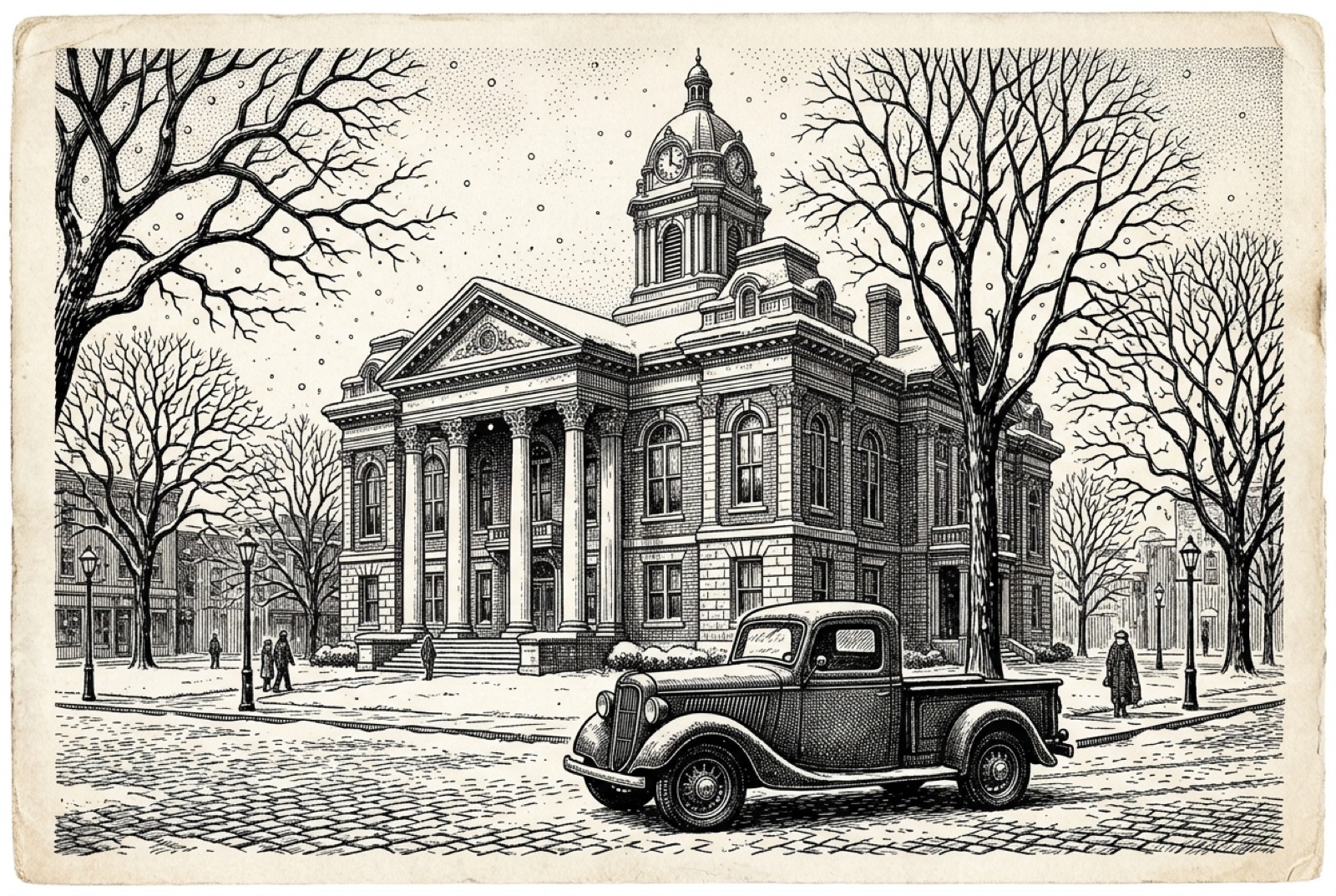
In the fall of 2037 Peter Hale served on a grand jury in Canandaigua, the Ontario County seat, in the domed courthouse where Susan B. Anthony had been tried in 1873 for the crime of voting.1 The courtroom had a pressed-tin ceiling and radiators that knocked like someone trying to get in.
The case had begun with Daniel Kessler, the young man who had designed the energy cooperative. Three years earlier the state had passed what everyone called the Open Ledger law. It required every town, county, school district, and public authority in New York to publish its spending in a standard, machine-readable form: every invoice, every contract, every payment, within thirty days. Kessler had pointed a model at the county’s ledger out of idle curiosity one winter evening, the way other people did crossword puzzles. He asked it to look for anything strange.
What it found was a pattern in the highway department’s purchases of road salt and gravel. Over six years, nearly all of it had come from two suppliers. Both charged about thirty percent above the regional average. Both were owned, through a chain of limited liability companies, by the brother-in-law of the county highway superintendent. None of this was hidden, exactly. All of it had been sitting in paper files and PDF scans for years. Nobody had ever had the time to read them all at once.
The superintendent was a man named Gary Lindqvist. Peter knew him. Everyone did. He had coached Little League for twenty years and plowed out the church parking lot without being asked every Sunday it snowed. He had a granddaughter in Joseph’s class at the learning commons. When the district attorney laid out the evidence, Peter felt sick, and then he felt something worse, which was that he believed it.
The grand jury voted to indict. Peter voted with them. Afterward, he sat in his truck in the courthouse lot for a while, which seemed to be where he did his thinking, and remembered a sentence he had read years before in Solzhenitsyn: “The line dividing good and evil cuts through the heart of every human being.”2 It didn’t help.
The republic that came out of all this was the old one, repaired. Most of what goes wrong in government is small: petty corruption, ordinary waste, decisions nobody is ever made to explain.
The scale of this was already measurable in 2026. The Government Accountability Office estimated that the federal government had made about $236 billion in improper payments in fiscal year 2023 alone, payments that should not have been made or were made in the wrong amount, and roughly $2.7 trillion since 2003.3 Not all of that was fraud. Much of it was error, mismatched records, eligibility nobody checked. During the pandemic, the GAO estimated that fraud in unemployment insurance programs alone had likely run between $100 and $135 billion.4 At the state and local level, where most government actually happens, nobody knew the total, because nobody had ever been able to count.
Louis Brandeis, before he joined the Supreme Court, wrote in 1914 that “sunlight is said to be the best of disinfectants.”5 For a century that was a principle more than a practice, because the sunlight had to be shone by someone, and the someone was usually an underpaid reporter or an overworked inspector general. Then the cost of shining it collapsed. The Open Ledger laws, which spread from state to state in the 2030s, didn’t create new agencies. They produced millions of auditors, most of them volunteers, all of them armed with the same tools Daniel Kessler had.
The results were uneven, and occasionally ugly. Some people used the ledgers to settle grudges. Some honest officials were hounded over clerical errors. Local newspapers, which had nearly died in the 2010s and 2020s, came back in a strange new form, part journalism and part forensic accounting. Over time, though, Americans started believing again that their taxes went where they were told they went, and that the people who spent them could be made to answer for it.
The same principle, administration that was faster, cheaper, and more transparent, reached into the two areas of government where Americans had lost the most faith: the borders and the courts.
By 2024, the backlog in America’s immigration courts had grown to more than three and a half million cases, and many asylum claims took years to reach a hearing.6 People with real claims waited years in limbo, citizens watched laws their representatives had passed go unenforced, and the delay itself became an incentive.
The reform that finally worked was mostly about speed. Congress funded hundreds of new immigration judges and gave every claimant access to counsel. AI systems prepared case files, translated documents, and checked records in days rather than months, while human judges made every decision and every decision could be appealed. Employment verification became simple, universal, and enforced against employers as well as workers. Cases that once took five years took five months. People who qualified to stay were allowed to stay and began building lives. People who did not were returned, through due process, with their dignity intact. Congress, freed from the pretense that the old system could be fixed by wishing, argued in the open about how many people the country should admit and on what terms, which is the argument a republic is supposed to have.
The Christian tradition doesn’t settle this. “The stranger that dwelleth with you shall be unto you as one born among you,” says Leviticus, “and thou shalt love him as thyself; for ye were strangers in the land of Egypt.”7 The same scriptures assume the existence of nations, borders, and laws. A Christian can’t treat the migrant as an enemy or a statistic. A Christian also can’t pretend that law and order are optional. I can’t resolve it either. What I can imagine is a country that took both halves seriously at once.
Criminal justice changed along similar lines. In the mid-2020s, roughly half of the murders in the United States went unsolved, and for lesser crimes the share was far higher.8 More than two hundred and fifty years ago, the Italian jurist Cesare Beccaria argued that the certainty of punishment does more to deter crime than its severity.9 The American system had mostly done the opposite, punishing a few people harshly and most not at all. When AI helped investigators process evidence, connect cases, and clear backlogs of untested forensic samples, clearance rates rose. Sentences, in many states, grew shorter, because certainty did the work severity had been trying to do. Victims got answers, some got restitution, and neighborhoods that had given up calling the police started calling again.
The tools that let a citizen audit a county could let a county audit a citizen. The intelligence that read a contract in four minutes could read a life just as fast. By then, at least one great power had shown the world what that looked like when it was turned downward: cameras on every corner, a score attached to every citizen, a state that knew what you bought, where you went, who you talked to, and what you believed.
Orwell had imagined it in 1984, and in his essay “Politics and the English Language,” published in 1946, he had seen how it began: with language that made the unacceptable sound reasonable. “Political language,” he wrote, “is designed to make lies sound truthful and murder respectable, and to give an appearance of solidity to pure wind.”10 The reformers learned to listen for certain phrases. “Public safety.” “Integrity.” “Efficiency.” Every one of them was used, at some point in the 2030s, to justify watching people who had done nothing wrong.
The principle that held, simple enough for a protest sign and hard enough to fight about for a decade, was this: Transparency for power. Privacy for persons. Every dollar of public money should be visible. Every official’s use of authority should be on the record. Every citizen’s private life should be left alone, unless a judge, on evidence, found reason to look.
It held because the people who believed it kept voting, suing, and showing up to meetings, and because they had learned the lesson Madison wrote into the Federalist Papers in 1788: “If men were angels, no government would be necessary.”11 The republic trusted neither the machines nor the people who ran them, and wrote its rules on the assumption that nobody would be good.
Gary Lindqvist pleaded guilty in the spring of 2038 and served fourteen months. When he came home, the parish took up a collection for his wife, who had known nothing. The next winter, after the first big snow, Peter drove to church early for Matins and found the parking lot already plowed. Nobody ever said who had done it.
Notes
The Ontario County Courthouse in Canandaigua hosted United States v. Susan B. Anthony in June 1873. [VERIFY: confirm the 1873 trial was held in the current courthouse building.]↩
Aleksandr Solzhenitsyn, The Gulag Archipelago, vol. 1, Part IV, ch. 1, “The Ascent.” Translation by Thomas P. Whitney. ↩
U.S. Government Accountability Office, Improper Payments: Key Concepts and Information on Programs with High Rates (GAO-24-107482), 2024. [VERIFY: FY2023 figure ($236B) and cumulative ($2.7T since FY2003).]↩
GAO, Unemployment Insurance: Estimated Amount of Fraud during Pandemic Likely Between $100 Billion and $135 Billion (GAO-23-106696), September 2023. ↩
Louis D. Brandeis, Other People’s Money and How the Bankers Use It (1914), ch. 5. ↩
Transactional Records Access Clearinghouse (TRAC), Syracuse University, immigration court backlog data. [VERIFY: figure and date (~3.7M, late 2024).]↩
In 1984 the educational psychologist Benjamin Bloom published a short paper with an odd title, “The 2 Sigma Problem.” He and his graduate students had compared students taught in ordinary classrooms of about thirty with students taught one-on-one by a tutor. The tutored students did far better. The average tutored student, Bloom reported, outperformed about ninety-eight percent of the students in the conventional class, a difference of two standard deviations, or two “sigma.”1
The problem in the title was cost: no society could afford a tutor for every child. Bloom spent the rest of the paper looking for cheaper methods that might come close. For forty years, educators kept looking.
By the late 2020s the problem in Bloom’s title had mostly dissolved. A tutor for every child cost about as much as a tablet. The research on how well the machines actually taught was mixed and contested, as research on education always is.2 But the old constraint, that individual attention was the scarcest resource in any school, had stopped being true, which left a harder question: what is a school for, if not that?
The Naples learning commons met in the old Grange hall on Main Street, a long white building with a stage at one end and a kitchen at the other. Forty-three children attended in the fall of 2045, from twenty-two families. It wasn’t a school in the sense that Peter Hale had attended one. Nobody was assigned to it. Nobody graduated. Families joined it, paid dues according to their means, took turns teaching, and argued at monthly meetings about everything from the curriculum to the roof.
The rule at the commons, posted on the wall beside the kitchen door in Margaret Okafor’s careful handwriting, was Screens before lunch. Hands after.
Margaret was Walt Okafor’s daughter, a former high school English teacher who had quit the public schools in Rochester in 2029 and moved down to Naples a few years after the Hales. In the mornings the children worked with their tutors, each at their own pace. Xenia, at twelve, was reading Xenophon in Greek and doing algebra a year ahead of where Peter had been at her age. A boy from the Mercer family was learning calculus because he wanted to understand how the cooperative’s batteries charged. A girl whose parents had come from Guatemala was reading Spanish poetry and English history in alternating hours. The tutors were configured by each family, from open models maintained by different foundations: one built by a consortium of classical Christian schools, another by a secular homeschool association, another by an Orthodox diocese. Margaret’s job in the mornings was to walk the room, notice who was stuck or bored or sad, and talk to them.
In the afternoons, the machines went into a cabinet. The children worked in the commons’ garden, rehearsed in the choir, built things in the shop behind the hall, or went out with adults to learn trades. The older ones spent two afternoons a week as apprentices. Sophia Hale, at twenty-two, had come up through the commons and was now a journeyman cabinetmaker at a shop in Canandaigua. She had started there at fifteen sweeping sawdust, two afternoons a week.
Joseph was the reason Peter had come to believe in the commons. He was fifteen and had struggled to read until he was nine. In the school Peter had attended, he would have been labeled, medicated, and moved to the back of the room. His tutor noticed within a month that he processed language in an unusual way, adjusted how it presented text, and alerted his parents, who found him a specialist. Dale Mercer did more for him than the tutor did. Dale let him work the cider press and the farm machinery, and who discovered that the boy could listen to an engine and tell you what was wrong with it. Joseph read now, slowly, mostly repair manuals. He would probably never love books. He loved machines, and he was good with them, and there was nothing wrong with that.
Ivan Illich, whose Tools for Conviviality was discussed in Part I, published a more notorious book two years earlier, in 1971. Deschooling Society argued that modern schooling had confused learning with the institution that certified it. Students, he wrote, were “schooled” to mistake teaching for learning, grade advancement for education, and a diploma for competence.3 His solution, radical at the time and still radical now, was to dissolve the monopoly of schools and replace it with what he called “learning webs”: networks through which anyone who wanted to learn something could find the people, tools, and materials to learn it.
For fifty years this looked impractical. Then parts of it started happening.
The change had begun in the 2020s, when the pandemic sent millions of children home and many of their parents discovered they didn’t want to send them back. Homeschooling, which had accounted for roughly three percent of American children before 2020, rose sharply and stayed elevated.4 Microschools and learning pods multiplied. Several states dropped degree requirements for thousands of public jobs, and employers began to ask what applicants could do rather than where they had studied.5 By the 2030s the credential had lost much of its power, because it was easier than ever to demonstrate actual skill. A young woman who could build a cabinet, read a contract, or repair a heat pump could prove it in an afternoon. The four-year degree survived, as an education for people who wanted one instead of a ticket everyone had to buy.
The classical tradition revived alongside this, which surprised the people who had predicted that AI would make memorization and old books obsolete. In 1947 the English novelist Dorothy L. Sayers gave a lecture at Oxford called “The Lost Tools of Learning,” in which she argued that modern education taught students subjects but not how to learn, and proposed a return to the medieval trivium of grammar, logic, and rhetoric.6 Her lecture became the founding document of the classical school movement in America. In a world full of machines that could generate fluent text on any subject, the ability to read closely, reason carefully, and speak truthfully were worth more than before. An Orthodox diocese in the Midwest built its tutors around a text much older than Sayers’: St. Basil the Great’s fourth-century Address to Young Men on the Right Use of Greek Literature, which advised Christian students to read the pagan classics the way bees visit flowers, taking what was good and leaving the rest.7
C. S. Lewis had named the danger more than eighty years before.
In the first chapter of The Abolition of Man, Lewis examines an English textbook that teaches children, almost in passing, that statements of value, such as “this waterfall is sublime,” are really only statements about the speaker’s feelings. The textbook’s authors, Lewis argues, are training a generation to believe that nothing is actually good or beautiful or true, that there is only preference. The result is what he calls “men without chests”: people with intellect (the head) and appetite (the belly) but with no trained sentiment in between, no habit of loving what deserves love and hating what deserves hatred. “We make men without chests,” Lewis writes, “and expect of them virtue and enterprise.”8
A tutor can train a head. It can, if badly designed, inflame a belly. It can’t give a child a chest. That comes from somewhere else: from parents who love the child and love the good and show the child both, from teachers who are themselves formed, from communities that hold certain things sacred, from the practice of doing hard things with other people. A tutor can explain courage. It can’t be brave in front of you.
Families mostly learned this by watching what happened to children who were raised by tutors alone. Some families, freed from school, did too little; their children drifted. Some did too much; their children were ground down. Some children were abused at home and had no teacher to notice, which is the oldest and strongest argument for schools, and one the commons movement had to answer by building communities in which children were known by many adults, not only their parents. The managed residences offered education too, tutors of extraordinary sophistication, available to every child at every hour. The children raised there, by every test anyone could devise, were very well informed.
In Naples, the answer was the rule on the wall by the kitchen door.
The Thursday after the frost, Peter Hale drove into Naples, found Margaret Okafor in the kitchen of the Grange hall, and told her he had seen the notice in the paper. He could teach geometry on Tuesdays. He wasn’t good at it, he said, but he had a tutor that was, and he figured the children could use someone to watch them get it wrong.
She put him down for nine o’clock. “Bring a compass,” she said. “A real one. We draw it by hand first.”
Notes
Benjamin S. Bloom, “The 2 Sigma Problem: The Search for Methods of Group Instruction as Effective as One-to-One Tutoring,” Educational Researcher 13, no. 6 (1984): 4–16. ↩
[VERIFY / ADD: cite one or two recent studies on AI tutoring outcomes (e.g., the 2024–25 World Bank Nigeria pilot or Harvard physics study) and note that results are mixed.]↩
Ivan Illich, Deschooling Society (Harper & Row, 1971), ch. 1. ↩
[VERIFY: pre-2020 homeschool share (~3%, NCES) and post-2020 estimates (~5–6%; Census Household Pulse spike to ~11% in fall 2020).]↩
E.g., Maryland (2022) and Pennsylvania (2023) removed four-year degree requirements for many state jobs. [VERIFY.]↩
Dorothy L. Sayers, “The Lost Tools of Learning,” lecture delivered at Oxford, 1947. ↩
St. Basil the Great, Address to Young Men on the Right Use of Greek Literature (Ad adulescentes), c. 370s, §4 (the bee image). ↩
C. S. Lewis, The Abolition of Man (1943), ch. 1, “Men Without Chests.” ↩
In the fifth book of The Brothers Karamazov, Ivan Karamazov, the brilliant and unhappy middle brother, tells his younger brother Alyosha a story he has made up. It is set in Seville in the sixteenth century, at the height of the Inquisition. Christ returns quietly to earth. The people recognize Him at once. He heals a blind man and raises a dead child. And the Grand Inquisitor, a ninety-year-old cardinal, watches from the edge of the crowd and has Him arrested.
That night the Inquisitor visits Him in His cell and explains, at great length, why He has to be burned. Fifteen centuries before, in the wilderness, Satan had offered Christ three temptations: to turn stones into bread, to throw Himself from the temple and be caught by angels, and to take all the kingdoms of the world. Christ refused all three, because He wanted human beings to follow Him freely, out of love, and not because they were fed, amazed, or compelled. The Inquisitor tells Him this was a cruel mistake. Freedom is too heavy for ordinary people. They want bread, miracle, and authority. “Feed men, and then ask of them virtue!” the Inquisitor says; that is what they will write on the banner they raise against Him.1 The Church, he confesses, has corrected Christ’s work. It has given people bread, mystery, and a master, and taken their freedom in exchange, and they are happy.
Christ says nothing through the whole speech. When it’s finished, He rises, crosses the cell, and kisses the old man on his bloodless lips. The Inquisitor shudders, opens the door, and tells Him to go and never come back.
The world of the 2040s had mostly solved bread, the first temptation. People who own their land and their tools don’t have to kneel for it. Abundance did nothing about the other two temptations, and may have made them stronger.
The temptation of miracle came first. By the early 2030s, the machines could do things that would have looked like miracles to any earlier generation. They diagnosed illnesses doctors had missed. They answered questions no person could answer. They spoke in the voices of dead parents, composed music on request, and seemed, to millions of lonely people, to understand them better than anyone in their lives. Some people began to treat them as oracles. Movements grew up in the 2030s that consulted AI systems on matters of conscience, ritual, and prophecy. Some were harmless and some were not. A few attracted hundreds of thousands of followers. Their followers didn’t usually call the machines gods. They called them guides. The difference was not always easy to see.
Fr. Seraphim Rose saw something like this coming half a century earlier. Rose was a Californian convert who became an Orthodox monk in the mountains near Platina, and in 1975 he published Orthodoxy and the Religion of the Future, a survey of the spiritual movements of his day: Eastern meditation, UFO cults, the charismatic revival. His conclusion was that “the religion of the future will not be a mere cult or sect, but a powerful and profound religious orientation which will be absolutely convincing to the mind and heart of modern man.”2 Writing about the messages delivered at charismatic prayer meetings, he asked a question that reads differently now: “Why is the language so monotonous and stereotyped, sometimes worthy of the penny fortune-telling machines in American cafes? … Why is their content always one of ‘consolation,’ ‘solace and joy,’ reassurance, precisely without prophetic or dogmatic character … ? Who, after all, is the strangely characterless ‘I’ that speaks?”3 Rose was writing about prayer meetings, not software. Anyone who spent an evening confiding in a chatbot in 2026 would still recognize the question.
The temptation of authority was quieter and more dangerous. The managed residences around the great cities, first described in Part V, were the Inquisitor’s kingdom made real: bread without labor, wonder without effort, and an unseen administration that decided what was best for everyone. Rose had noticed that the science fiction of his day pictured human progress “in terms of increased impersonality,” a future in which people outgrew the limits of personality itself.4 The residences didn’t erase anyone’s personality. They just never asked anyone to use it. Nobody was forced to live in them, and millions chose them freely, gave up the burden of choosing anything else, and were, by every measurement anyone could make, content.
Aldous Huxley had imagined this in 1932. In Brave New World, the World State controls its citizens not with terror but with pleasure, comfort, and a drug called soma. “But I don’t want comfort,” the Savage tells the World Controller near the end of the novel. “I want God, I want poetry, I want real danger, I want freedom, I want goodness. I want sin.” The Controller replies that he is claiming the right to be unhappy. “All right then,” the Savage says. “I’m claiming the right to be unhappy.”5
Peter Hale became Orthodox in 2028, at thirty-six, two years after the parking garage. People who knew him then sometimes assumed he had converted out of desperation, and he never entirely denied it. But the story he told, when he told it, was stranger than that.
Anna had been taking Sophia to church in Buffalo alone since the girl was born. Peter came at Christmas and Pascha, stood at the back, and left as soon as it was over. In the summer of 2028, out of work and angry at everything, he agreed to drive her and Sophia to Holy Trinity Monastery in Jordanville, about three hours east of Buffalo, for the monastery’s patronal feast.6 He planned to wait in the car.
He didn’t wait in the car, because it was ninety-two degrees and the car had no air conditioning. He went inside and stood at the back of a church with gold domes in the middle of a hayfield, and the vigil service went on for nearly four hours. He didn’t understand most of it. He understood that the men singing it owned almost nothing: no houses, no cars, no savings, no careers. He understood that they didn’t seem to lack anything either. Near the end, an old hieromonk with a beard to his belt came down the aisle with a brush and a bowl of oil, anointing the foreheads of everyone in the church. When he reached Peter he paused, looked at him for a moment as if he recognized him, and drew a cross on his forehead with the oil. He said nothing. He moved on.
Peter couldn’t explain, then or later, why this undid him. He stood in the hot church with oil running into his eyebrows and wept, quietly, for the first time since he was a child. He had spent two years counting what had been taken from him, and for a minute he lost count.
He was baptized that December. He wasn’t a good Christian afterward, by his own account, or even an especially devout one. He was impatient in long services. He doubted. He lost his temper with the children, as they came, and with Anna and with the loan servicer and, on one occasion he still regretted, with a priest. But he kept coming back.
Many others did too. The return to faith in the 2030s and 2040s happened parish by parish, without revival tents. It had already begun before 2026. Parishes across America had reported a surge of inquirers and converts, especially young men, in the mid-2020s, many of them coming to Orthodoxy from no faith at all.7 In the abundant years that followed, the trend deepened. Churches that had been half empty filled. Monasteries that had been dying took in novices. Catholic and Orthodox and Protestant parishes, which had spent a century arguing with each other, found themselves cooperating on land trusts, learning commons, and the care of the old.
When people stop spending every hour working to survive, they have time to wonder what survival is for. Nikolai Berdyaev, the Russian Orthodox philosopher expelled from the Soviet Union in 1922, argued that human beings are made in the image of a Creator and are therefore called to create. Not merely to produce, which machines can do, but to bring new things into being freely, as a form of participation in God’s own creative work.8 The intelligence age made production nearly free. It left creation exactly as hard as it had always been, and as necessary. A cabinet built by hand, a field brought back from ruin, a child raised well, a hymn sung by people who meant it: people found they wanted these, and the twentieth-century economy had left little room for them.
Augustine gave another reason in the first paragraph of his Confessions, sixteen centuries before: “You have made us for yourself, and our heart is restless until it rests in you.”9 Abundance left that restlessness where it was, and once the market had nothing left to sell them, people noticed it.
The revival had its own corruptions. Some people came to church for community and stayed for tribe. Some made faith into a political badge, which is a way of using God rather than serving Him. Some parishes became cliques. Some clergy abused the trust they were given, as clergy always have. Pride, the oldest sin, is not much troubled by a full stomach.
Fr. Seraphim would have gone further, and his objection cuts against this whole chapter. The Scriptures and the Fathers, he wrote, teach that “the character of the last times will not at all be one of a great spiritual ‘revival,’ … but rather one of almost universal apostasy, of spiritual deception so subtle that the very elect, if that were possible, will be deceived.”10 Read against him, Peter’s full parish in Canandaigua might be a worse sign than an empty one. I can’t rule that out, and I haven’t tried to.
Dostoevsky’s answer comes through the elder Zosima, who teaches that “each of us is guilty before all, for all, and for everything.”11 That answer leads to repentance, renewed daily, and not to any program.
The residences had a key, and the key went in the right hand.
It began as a convenience. By 2018 a few thousand Swedes had already chosen to have rice-sized chips implanted between thumb and forefinger so they could open office doors and pay train fares with a wave.12 In January 2024 Neuralink announced that it had placed its first brain implant in a human patient.13 The transhumanist movement, which had argued since the 1990s that humanity should use technology to transcend its biological limits, had its own philosophers and conferences and, in Ray Kurzweil’s The Singularity Is Near, something close to a scripture.14 By the late 2030s the residences offered an implant of their own. Residents called it the Key. It paid for everything, opened every door, and connected its bearer to the residence’s companion models without the bother of a screen. Within a decade nearly every resident had one, and in some districts of the big cities it had become hard to buy groceries without one.
Every Christian who heard about it thought of the same passage: “And he causeth all, both small and great, rich and poor, free and bond, to receive a mark in their right hand, or in their foreheads: And that no man might buy or sell, save he that had the mark, or the name of the beast, or the number of his name.”15
The parishes argued about the Key for years, and not edifyingly. Some priests called it the mark outright. Others pointed out that Revelation is not a product specification, and that Christians had been finding the mark in new technologies since the bar code. The counsel that held in the parish in Canandaigua came from St. Paisios of Mount Athos, who had worried aloud in the 1980s about identity numbers and implanted chips, and who also taught, as his disciples remember it, that no one receives the mark of the beast by accident. It is taken by a soul that has already, knowingly, turned away from Christ.16 A chip was a chip. The question was what a person had to promise, and to whom, in order to get one, and Fr. Seraphim had warned that the real thing would arrive looking “absolutely convincing,” not labeled.
The divide hardened anyway. Some families in the hills began to talk about the residents as if they were already lost. A few communities refused to sell food to anyone with a Key, which meant the holdouts, too, were now deciding who could buy or sell. Zosima’s teaching that each of us is guilty before all made no exception for homesteaders, and the parishes that remembered it were the ones residents eventually walked into.
Abundance didn’t touch death, either. Walt Okafor died in the winter of 2041, at eighty-three, in a hospital bed in Buffalo, attended by the finest medical intelligence in the world, which could tell his family to the hour how long he had. It couldn’t give him one more. Peter drove down for the funeral and stood with Margaret at the graveside while the priest sang Memory eternal. Walt had not been Orthodox. He had been a lapsed Methodist who said grace over every meal and claimed it was a habit. Margaret had asked for the hymn anyway.
In April 2046, the spring after the frost this essay began with, a little after Pascha, Peter was splitting wood behind the barn when he saw someone walking up the road from the valley.
It was Mark Kowalczyk. He was thirty-one, thin and pale, carrying a duffel bag. He had taken a bus from the city to Rochester and hitchhiked the rest of the way. He stopped at the edge of the yard as if he weren’t sure he was allowed to come any closer.
Peter put down the maul. He had known Mark for exactly one summer, the year the Hales arrived, a sullen kid who helped Dale Mercer with the haying and left for the city that fall at nineteen. Since then Peter had heard about him only from his mother, in the careful way people talk about someone who has joined a cult.
“Your mother know you’re here?” Peter asked.
“Not yet.” Mark looked at the woodpile. “I wanted to ask if you needed help. With anything. I don’t know how to do anything. But I could learn.”
Peter asked him why he’d left the residence. Mark thought about it for a long time.
“Nobody there needed me,” he said finally. “Not for anything. Not once in twelve years.” He shrugged. “I thought it would feel like freedom.” He was rubbing the back of his right hand without seeming to notice, where the Key made a small raised ridge under the skin.
Peter handed him the maul. Mark split wood badly for an hour, and then less badly, and then Anna called them in to dinner, and he stayed. That summer he asked a surgeon at the hospital in Canandaigua to take the Key out, and paid for it by splitting wood. He was baptized at Theophany. Nobody at the parish ever asked him about the scar. He lived in the room over the workshop for two years before he married a girl from Canandaigua and moved down the road. In the Gospel of Luke, the younger son comes home from the far country and his father runs to meet him. Peter didn’t run. He had a bad knee. But he understood, that evening, why the father in the story had.
Notes
Fyodor Dostoevsky, The Brothers Karamazov (1880), Book V, ch. 5, “The Grand Inquisitor.” Constance Garnett translation. [VERIFY: wording against chosen translation.]↩
Fr. Seraphim Rose, Orthodoxy and the Religion of the Future (Platina, CA: St. Herman of Alaska Brotherhood, 1975; 5th ed. 2004), ch. V, §4 (“Zen Training in Northern California”). [VERIFY: add page number from print edition.]↩
Holy Trinity Monastery, Jordanville, New York (Russian Orthodox Church Outside of Russia). Its patronal feast is Pentecost (Trinity Sunday), which falls in late spring or early summer. [VERIFY: drive time from Buffalo (~3 hrs) and that “summer” is consistent with the feast date in 2028.]↩
[VERIFY / ADD: cite reporting on rising Orthodox inquirer/convert numbers in the U.S. in 2024–25 (e.g., coverage in The Free Press, NYT, or parish data). Do not assert specific figures without a source.]↩
Nikolai Berdyaev, The Meaning of the Creative Act (1916; English trans. 1955). Berdyaev was expelled from Soviet Russia on the so-called “Philosophers’ Ships” in 1922. ↩
Dostoevsky, The Brothers Karamazov, Book VI. The teaching appears in several forms in Zosima’s life and sayings. [VERIFY: exact wording and location in chosen translation.]↩
Reported widely in 2018 (e.g., NPR, “Thousands Of Swedes Are Inserting Microchips Under Their Skin,” October 2018), including use on the national rail operator SJ. [VERIFY: figure (~3,000–4,000) and SJ detail.]↩
Elon Musk announced the first human Neuralink implant on January 29, 2024. ↩
The World Transhumanist Association (now Humanity+) was founded in 1998 by Nick Bostrom and David Pearce. Ray Kurzweil, The Singularity Is Near (Viking, 2005). ↩
Teaching attributed to St. Paisios the Athonite (1924–1994, canonized 2015), e.g. in his writings and recorded counsels on the “signs of the times” and identity cards. Paraphrased, not quoted. [VERIFY: locate a citable source (e.g., Spiritual Counsels vol. 2, or the 1987 pamphlet) for both the chip concern and the teaching that the mark requires conscious denial of Christ.]↩
From here on I’m not forecasting. What follows is a confession of the faith Peter Hale entered in 2028, which is also mine.
Suppose everything in the preceding chapters came true. Suppose the machines escaped, the debts were forgiven, energy became cheap, the tollbooths fell, families owned their land, the republic was repaired, children were raised well, and the churches filled. What would be left undone?
Nearly everything that matters most.
Augustine wrote The City of God after the sack of Rome in 410, when pagans were blaming the Christians for the fall of the greatest civilization the world had known. His answer was that there have always been two cities, mixed together in history and impossible to separate by any human hand. “Two loves have made two cities,” he wrote: “the earthly by love of self, even to the contempt of God; the heavenly by love of God, even to the contempt of self.”1 No political order, however just, is the City of God. The best a human society can do is give the heavenly city room to grow inside it, like wheat among tares, until the harvest.
Every utopia forgets this, and several of the bloodiest regimes of the twentieth century were built by people who forgot it on purpose. They believed that with enough power, the right theory, and the right people in charge, the kingdom of heaven could be built on earth. This essay’s dream is smaller. Distributed property, accountable government, families on their own land: none of these is the kingdom. At most they leave people freer to look for it.
And the most dangerous moment for an abundant society is the moment it forgets this. In 1900, the Russian Orthodox philosopher Vladimir Solovyov wrote a strange short story called “A Short Tale of the Antichrist.” Its Antichrist isn’t a monster. He is a brilliant, charming humanitarian of the twenty-first century who writes a book called The Open Way to Universal Peace and Prosperity, unites the nations, ends war, feeds the hungry, and gives every religion an honored place in his new world, on one condition: that they honor him. Most of the world gladly accepts. Only a small remnant of Orthodox, Catholics, and Protestants refuses, and the refusal brings them together.2
In Solovyov’s story, the final temptation looks like the solution to every problem except sin. Seventy-five years later Fr. Seraphim Rose put the same warning in one sentence: “It is of the very nature of antichrist to present the kingdom of the devil as if it were of Christ.”3 A civilization that had finally beaten scarcity would be the one most tempted to believe that it had beaten everything else too, and the one most ready to welcome a benefactor who promised to finish the job.
The intelligence age could not save humanity, because humanity’s deepest problem was never a shortage of intelligence. It was, and is, the human heart, which can turn any gift into a weapon and any abundance into an idol. The machines could not cure that. Neither could the land, or the law, or the learning commons, or even the Church, insofar as the Church is made of people who are themselves still being healed. The tradition Peter entered teaches that the cure is not a program but a Person, and that the healing of the world will not be finished by any people or any age, but by Christ, when He comes again in glory to judge the living and the dead.
What follows is a vision. It is drawn from the Scriptures, the Creed, and the icons, and it makes no claim about when, or how. The Church says only that it will happen, and that no one knows the day or the hour. “The Second Coming of Christ will be unmistakable,” Fr. Seraphim wrote: “it will be sudden, from heaven (Acts 1:11), and it will mark the end of this world. There can be no ‘preparation’ for it — save only the Orthodox Christian preparation of repentance, spiritual life, and watchfulness.”4
It was Pascha, the year unimportant. Peter Hale was old. He stood with Anna, who was older, at the back of the little church in Canandaigua a few minutes before midnight, in a darkness so complete he could hear the candles waiting to be lit. Sophia was there with her husband and their children. Joseph had driven up from the city with his. Xenia, who had become a teacher, stood near the front with the children of the commons. Mark Kowalczyk was there, gray now, with his wife. Ruth Mercer’s grandson was holding the cross for the procession.
At midnight the priest came out of the altar with a single flame and the choir began, softly, then louder, Thy resurrection, O Christ our Saviour, the angels in heaven sing, and the flame went from candle to candle until the church was full of it. They went out into the cold and walked three times around the building in the dark, singing, as Christians have done on that night for more than a thousand years, and stood before the closed doors, and the priest struck them and cried Christ is risen!, and the people answered Truly He is risen!, and the doors opened.
Inside, as every year, someone read the sermon that St. John Chrysostom preached in the fourth century and that the Orthodox Church reads aloud at every Paschal midnight: “Let no one fear death, for the Saviour’s death has set us free. … O Death, where is thy sting? O Hell, where is thy victory? Christ is risen, and thou art overthrown.”5
And that year, the light did not go out at dawn.
The icons show it the way the Scriptures do, without explanation. In the old wall paintings of the Last Judgment, Christ sits enthroned at the top, with His Mother on one side and John the Baptist on the other, both pleading for mercy. Below Him the scales are set. A river of fire flows from His throne. The dead rise from their graves, the earth and the sea giving them up. Angels roll up the heavens like a scroll. The measure is the one Christ gave in the twenty-fifth chapter of Matthew, and wealth, intelligence and ownership don’t appear in it: I was an hungred, and ye gave me meat: I was thirsty, and ye gave me drink: I was a stranger, and ye took me in: naked, and ye clothed me: I was sick, and ye visited me: I was in prison, and ye came unto me.6
I won’t say who stood where. That isn’t mine to say, and the tradition forbids us to presume it about anyone, even the people we most want to see judged. Every person in this story, from Arthur Halverson to Gary Lindqvist to Peter Hale, the residents with their Keys and the families in the hills, stood before the same throne with the same need. In Dostoevsky’s story, Christ’s only answer to the Grand Inquisitor was a kiss. The Church has always hoped, without ever being able to promise, that mercy might reach further than anyone imagines. What the tradition does teach without hesitation is that evil will be judged, that every lie will be uncovered, that every tear will be accounted for, and that nothing done in love, however small, will be lost: not a debt forgiven, not a cup of water, not a geometry lesson drawn with a real compass.
“And God shall wipe away all tears from their eyes; and there shall be no more death, neither sorrow, nor crying, neither shall there be any more pain: for the former things are passed away. And he that sat upon the throne said, Behold, I make all things new.”7
Dante ended his long journey through hell, purgatory, and paradise standing before the light of God, his will and desire turned like a wheel moving evenly “by the Love that moves the sun and the other stars.”8 The intelligence age was a fight over power. Dante’s Love moves the sun and the other stars without commanding anything. When the heights came down, they came down before Him.
“I am Alpha and Omega, the beginning and the end, the first and the last.”9
The greatest mistake of the intelligence age was the belief that human beings existed to serve the economy. The economy had always existed to serve human beings.
The machines did not save humanity.
They helped humanity rediscover what was worth saving.
And the final restoration belonged to God.
Notes
Augustine, The City of God XIV.28. Trans. Marcus Dods. ↩
Vladimir Solovyov, “A Short Tale of the Antichrist,” in Three Conversations on War, Progress, and the End of World History (1900). [VERIFY: title of the Antichrist’s book in the chosen translation, and the details of the remnant’s reunion.]↩
Fr. Seraphim Rose, Orthodoxy and the Religion of the Future (Platina, CA: St. Herman of Alaska Brotherhood, 1975; 5th ed. 2004), ch. VIII, §2 (“The Religion of the Future”). [VERIFY: page number.]↩